One pig-meat conglomerate buying another isn't typically my stock in trade, but I was intrigued by the recent news of the DOJ levying a $900K fine against Smithfield Farms for gun-jumping in its acquisition of Premium Standard Farms. Root of the problem? During the pre-close HSR waiting period, Premium Standard had submitted several long-term contracts for hog supply to Smithfield for review and approval. Sooey!
While the amount of the fine isn't huge (representing little more than one-tenth of one percent of the $810 million Smithfield paid), what's interesting is how after-the-fact it was. The deal closed nearly 3 years ago.
Lesson one, which isn't really a lesson, because both parties should have known better: Don't ask your acquiror to sign off on ordinary course contracts, even if they ARE large and DO extend beyond the closing date. Aside from the gun jumping risk, there are also significant benefits to the seller in maintaining its operational independence while awaiting the close (optionality in the event the deal goes south; additional motivation for the buyer to close quickly). And while the buyer's interest in making sure it's not saddled with non-economic contracts is obvious, tight operating covenants are a better solution than trying to assert de facto operating control pre-close.
Lesson two: Don't expect that closing the deal is the end of your dealings with the DOJ. If you haven't run a clean process, don't be surprised if the feds come calling long after the closing dinner is a distant memory.
Showing posts with label integration. Show all posts
Showing posts with label integration. Show all posts
Friday, February 19, 2010


Wednesday, November 29, 2006
Due Diligence - Buyers
Questions percolate in about the diligence process, so I thought I'd post some thoughts on various aspects of the process from the differing perspective of buyers and sellers. Today, the buyers:
As a buyer, your primary goal in diligence is simple:
Verify that the asset you are buying is essentially what you think it is.
However, buyers often run their diligence in ways that, at best, cost them money and time, and at worst ruin their deals. The two primary mistakes are using a cookie- cutter approach to diligence and over-reliance on outside help.
If an acquiror applies a standard diligence approach to all deals, it will inevitably be overdoing its diligence on many deals. A screaming deal - either due to price or strategic need - demands a very different level of diligence than a deal that is in the margins financially and for which there are strategic alternatives.
In the latter case, you'll want to go through everything at some level of detail, because even small hiccups could push your marginal deal into the red. In the former case, you should just be doing what I like to call "nuclear" due diligence - take a high level pass and make sure there is no radioactive waste: Subsidiary asbestos mining companies, crooked accounting - you get the idea. Subjecting such a deal to a rigorous diligence process is simply a waste of time and resources. Worse, since it is such a great deal, the delay inherent in doing such detailed work - and the annoyance it causes your target - may open a window for an interloping buyer to push you out of the way. If you went shopping for a new TV or computer last Friday, you would have seen this principle at work at Best Buy and Circuit City stores across the land: Not a lot of consultive selling; just a mad scramble to get the limited-quantity deals.
Relying over-much on outside accountants, consultants and lawyers complicates problem number 1. Diligence is in many ways an ass-covering exercise for those involved. In the absence of very clear guidance, even internal people will overdo diligence out of concern for missing something. External professionals will be even worse. Their incentives - financially, professionally and with respect to potential liability - are all aligned on the side of doing exhaustive diligence. As a buyer, you need to make sure they understand very clearly what your goals are for diligence in each case. Are you looking only for unexploded bombs, or for any accumulation of small liabilities? As is the case in many strategic deals, time to deal execution is often far more important than doing a complete diligence work-up.
As a buyer, it is important that you have a senior person running the diligence process so that the personalities can be controlled and the process tailored to the needs of the specific deal.
One final thought for buyers is the difference between valuation and integration diligence. In strategic deals involving significant integration issues, you need to do some high-level diligence on the integration process: Verify software platform versions, people issues, etc. However, the specifics of the integration process are unlikely to matter in verifying value or deciding whether the deal is go/no go. The tricky part is that your operating people will want to get into the specifics right away, because they are responsible for delivering the post-merger results. And of course, it's critical that integration happen quickly and smoothly so deal synergies can be fully realized. One approach that often works - particularly if you've been reasonable with valuation diligence up front - is to negotiate in the definitive docs a process for integration-related diligence between signing and closing. Such diligence won't be a closing condition, and it will be limited to integration-related information, but it can meet your need for speed in the stage up to signing while still getting the detail your ops folks need to start integration as quickly as possible.
As a buyer, your primary goal in diligence is simple:
Verify that the asset you are buying is essentially what you think it is.
However, buyers often run their diligence in ways that, at best, cost them money and time, and at worst ruin their deals. The two primary mistakes are using a cookie- cutter approach to diligence and over-reliance on outside help.
If an acquiror applies a standard diligence approach to all deals, it will inevitably be overdoing its diligence on many deals. A screaming deal - either due to price or strategic need - demands a very different level of diligence than a deal that is in the margins financially and for which there are strategic alternatives.
In the latter case, you'll want to go through everything at some level of detail, because even small hiccups could push your marginal deal into the red. In the former case, you should just be doing what I like to call "nuclear" due diligence - take a high level pass and make sure there is no radioactive waste: Subsidiary asbestos mining companies, crooked accounting - you get the idea. Subjecting such a deal to a rigorous diligence process is simply a waste of time and resources. Worse, since it is such a great deal, the delay inherent in doing such detailed work - and the annoyance it causes your target - may open a window for an interloping buyer to push you out of the way. If you went shopping for a new TV or computer last Friday, you would have seen this principle at work at Best Buy and Circuit City stores across the land: Not a lot of consultive selling; just a mad scramble to get the limited-quantity deals.
Relying over-much on outside accountants, consultants and lawyers complicates problem number 1. Diligence is in many ways an ass-covering exercise for those involved. In the absence of very clear guidance, even internal people will overdo diligence out of concern for missing something. External professionals will be even worse. Their incentives - financially, professionally and with respect to potential liability - are all aligned on the side of doing exhaustive diligence. As a buyer, you need to make sure they understand very clearly what your goals are for diligence in each case. Are you looking only for unexploded bombs, or for any accumulation of small liabilities? As is the case in many strategic deals, time to deal execution is often far more important than doing a complete diligence work-up.
As a buyer, it is important that you have a senior person running the diligence process so that the personalities can be controlled and the process tailored to the needs of the specific deal.
One final thought for buyers is the difference between valuation and integration diligence. In strategic deals involving significant integration issues, you need to do some high-level diligence on the integration process: Verify software platform versions, people issues, etc. However, the specifics of the integration process are unlikely to matter in verifying value or deciding whether the deal is go/no go. The tricky part is that your operating people will want to get into the specifics right away, because they are responsible for delivering the post-merger results. And of course, it's critical that integration happen quickly and smoothly so deal synergies can be fully realized. One approach that often works - particularly if you've been reasonable with valuation diligence up front - is to negotiate in the definitive docs a process for integration-related diligence between signing and closing. Such diligence won't be a closing condition, and it will be limited to integration-related information, but it can meet your need for speed in the stage up to signing while still getting the detail your ops folks need to start integration as quickly as possible.
Tuesday, April 18, 2006
Gun-Jumping
Sometimes it just doesn't pay to be a tough negotiator - witness Qualcomm's announcement Monday that it is entering into a consent decree with DOJ and paying $1.8M to settle claims of gun jumping in its acquisition of Flarion ("gun jumping" being where the acquiror starts getting a bit too intimate with the seller's business ops before the deal has closed).
While a buyer can't run the acquired business before the deal closes, there's always a healthy negotiation over the amount of control the buyer will exert (via operating covenants written into the acquisition agreement) during the pre-closing period. These covenants are typically designed to ensure that, to the extent possible, the acquired business continues to operate in a straight-and-narrow course until closing. Themes for operating covenants include the permissable amount of new debt, capital expenditue limits, asset sales, etc. - anything that might materially change the nature of what the buyer thought they were buying. However, buyers usually have to stay well clear of anything involving customers and markets, particularly when acquiring a competitor, to avoid the appearance of gun jumping.
Gun jumping is of heightened concern in industries like telecom, where the wait for closing can exceed one year. The long wait obviously increases the operating risk during the pre-closing period, thus ratcheting up the desire to steer the target's course during that period or get a jump on integration. Many M&A lawyers take a very conservative stance on gun jumping, preventing most conversation pre-close on the (not unreasonable) presumption that some business people will jump the gun. Buyers want to get moving; sellers usually want to be compliant - the gun gets jumped.
What's interesting about the Qualcomm news is that the claims don't relate to any over-reaching behavior by Qualcomm executives, but rather the language in the merger agreement itself.
Obviously the size of this fine is not material to Qualcomm or even this deal itself (the $1.8M fine is well less than one-half of one percent of the purchase price). However, I'm sure the threat of this action scuttling or slowing the deal caused many a sleepless night for those involved - and may still, if you are a Qualcomm lawyer.
While a buyer can't run the acquired business before the deal closes, there's always a healthy negotiation over the amount of control the buyer will exert (via operating covenants written into the acquisition agreement) during the pre-closing period. These covenants are typically designed to ensure that, to the extent possible, the acquired business continues to operate in a straight-and-narrow course until closing. Themes for operating covenants include the permissable amount of new debt, capital expenditue limits, asset sales, etc. - anything that might materially change the nature of what the buyer thought they were buying. However, buyers usually have to stay well clear of anything involving customers and markets, particularly when acquiring a competitor, to avoid the appearance of gun jumping.
Gun jumping is of heightened concern in industries like telecom, where the wait for closing can exceed one year. The long wait obviously increases the operating risk during the pre-closing period, thus ratcheting up the desire to steer the target's course during that period or get a jump on integration. Many M&A lawyers take a very conservative stance on gun jumping, preventing most conversation pre-close on the (not unreasonable) presumption that some business people will jump the gun. Buyers want to get moving; sellers usually want to be compliant - the gun gets jumped.
What's interesting about the Qualcomm news is that the claims don't relate to any over-reaching behavior by Qualcomm executives, but rather the language in the merger agreement itself.
Obviously the size of this fine is not material to Qualcomm or even this deal itself (the $1.8M fine is well less than one-half of one percent of the purchase price). However, I'm sure the threat of this action scuttling or slowing the deal caused many a sleepless night for those involved - and may still, if you are a Qualcomm lawyer.
Monday, April 03, 2006
Alcatel-Lucent
While the Alcatel-Lucent tie-up makes a lot of sense on paper, creating an integrated company in high-tech manufacturing is tricky business. Throw in the cross-border and cultural compatibility issues, and this looks to be at least as steep a climb as the HP-Compaq merger. I hope it works out better than that, but both companies are going to have to be very, very focused on executing their integration plan.
I know, that seems obvious - every company going through a merger should be focused on merger integration. However, big companies can't always get out of their own ways, and when the realities of quarterly results, competition and internecine fighting start kicking in, that focus can be lost. Some consolidating mergers can absorb these effects and still succeed - this one can't.
I know, that seems obvious - every company going through a merger should be focused on merger integration. However, big companies can't always get out of their own ways, and when the realities of quarterly results, competition and internecine fighting start kicking in, that focus can be lost. Some consolidating mergers can absorb these effects and still succeed - this one can't.
Monday, March 27, 2006
Merger Woes
Nothing relevatory here, but nice high-level list of some of the mistakes that can keep an acquiror from realizing value from an acquisition.
And speaking of value not realized, I had to chuckle at the news that Skype is now being sued over the IP acquired by Ebay in picking up Skype. I figured that Skype was primarily a marketing/sub acquisition play by Ebay, but some tried to convince me that the deal was primarily about Skype's technology. Let's hope not.
The lawsuit may be a whole lot of nothing, and the fact that the causes of action are styled as RICO claims makes me think there's more hyperbole than merit to them. But with questions over the transferability of the technology and the Skype founders' former business dealings, I'd say the Ebay/Skype deal isn't shaping up to be a nominee for the M&A hall of fame.
And speaking of value not realized, I had to chuckle at the news that Skype is now being sued over the IP acquired by Ebay in picking up Skype. I figured that Skype was primarily a marketing/sub acquisition play by Ebay, but some tried to convince me that the deal was primarily about Skype's technology. Let's hope not.
The lawsuit may be a whole lot of nothing, and the fact that the causes of action are styled as RICO claims makes me think there's more hyperbole than merit to them. But with questions over the transferability of the technology and the Skype founders' former business dealings, I'd say the Ebay/Skype deal isn't shaping up to be a nominee for the M&A hall of fame.
Sunday, February 19, 2006
Chaos and Opportunity
I’m not sure what’s got me thinking so much about the employee impacts of M&A lately – maybe it’s all the stories I hear whenever I get together with my former colleagues who are still at Cingular. As I’ve posted before, a merger is a tough thing to go through, particularly if a lot of the work you do is forward-looking. Of course, the flip side is that – as with any corporate situation involving wholesale change – there are often new opportunities amidst the chaos.
While senior people are likeliest to move on to other companies, and junior people may not feel they have access to these opportunities, those in the middle should be looking for every way to use the merger as an avenue to a bigger role. Regardless of level, being proactive is critical. It’s fine to grieve for your old company and the way things were, but don’t give in to the endless grousing that many in the acquired company give in to. Check out the terrain of the new company and start talking to people – positively – about what you can contribute. You’ll quickly find out whether there are golden opportunities or you should run fleeing for the door. Either way, you’re far better off than if you sat back morosely and waited for a pink slip.
Here’s a method I learned quite some ago from an employee of mine: I’d taken over her 10-person group, and she knew I would need to lay off half the group, including her. Instead of sulking or delaying, she came right out with it, acknowledging the reality and offering suggestions for the new staffing plan. She also asked that we pick a date for her to be laid off. Because she did this in our first or second meeting, she was able to get a date nearly four months out – which was probably 3 months more notice than she would have had if she had simply ignored the issue and waited for me to finalize a staffing plan and lay her off. This gave her plenty of time to ramp her job search up and find something new by the time her layoff date arrived. In fact, with luxury of extra time, she was able to find another job in the company, saving me the severance expense!
From almost any manager’s perspective, an employee this proactive is an enormous relief. As a manager, you never know how a termination discussion is going to turn out, or what kind of performance you’re going to get leading up to the termination. Instead, you’ve got an employee offering their professional best in return for some certainty on when they’ll be let go. It doesn’t involve more cost to the company, because you’re not delaying a layoff date – you’re simply providing more notice. It’s a brilliant solution for all involved.
Even if it’s not certain that your position will be eliminated, it’s still a great idea to be proactive with your new managers. If you really want out, it will maximize your chances of getting out on your timetable. If you want to stay, it’s a great way to display your professionalism and interest in staying with the new company. I’ve done this both times my company was acquired – once when I wanted to stay, and once when I wanted to leave – and it worked beautifully both times.
While senior people are likeliest to move on to other companies, and junior people may not feel they have access to these opportunities, those in the middle should be looking for every way to use the merger as an avenue to a bigger role. Regardless of level, being proactive is critical. It’s fine to grieve for your old company and the way things were, but don’t give in to the endless grousing that many in the acquired company give in to. Check out the terrain of the new company and start talking to people – positively – about what you can contribute. You’ll quickly find out whether there are golden opportunities or you should run fleeing for the door. Either way, you’re far better off than if you sat back morosely and waited for a pink slip.
Here’s a method I learned quite some ago from an employee of mine: I’d taken over her 10-person group, and she knew I would need to lay off half the group, including her. Instead of sulking or delaying, she came right out with it, acknowledging the reality and offering suggestions for the new staffing plan. She also asked that we pick a date for her to be laid off. Because she did this in our first or second meeting, she was able to get a date nearly four months out – which was probably 3 months more notice than she would have had if she had simply ignored the issue and waited for me to finalize a staffing plan and lay her off. This gave her plenty of time to ramp her job search up and find something new by the time her layoff date arrived. In fact, with luxury of extra time, she was able to find another job in the company, saving me the severance expense!
From almost any manager’s perspective, an employee this proactive is an enormous relief. As a manager, you never know how a termination discussion is going to turn out, or what kind of performance you’re going to get leading up to the termination. Instead, you’ve got an employee offering their professional best in return for some certainty on when they’ll be let go. It doesn’t involve more cost to the company, because you’re not delaying a layoff date – you’re simply providing more notice. It’s a brilliant solution for all involved.
Even if it’s not certain that your position will be eliminated, it’s still a great idea to be proactive with your new managers. If you really want out, it will maximize your chances of getting out on your timetable. If you want to stay, it’s a great way to display your professionalism and interest in staying with the new company. I’ve done this both times my company was acquired – once when I wanted to stay, and once when I wanted to leave – and it worked beautifully both times.
Monday, February 13, 2006
Cultural Compatability
An amusing bit from a recruiting perspective, critiquing the widely-held belief that “talent” is the be-all-end-all in adding new employees. I particularly like the analogy of a company to a human body, the existing employees to antibodies, and new hires to foreign pathogens. I think the point is well-taken, and the reason so many new hires do go on to succeed - and despite being “pathogens” find themselves embraced by their new colleagues - is because their new employers hired them based on how well they would “fit” in the new corporate culture. Once the “fit” is established, the talent can flourish.
Considerations of fit and cultural compatibility are similarly worth thinking about when acquiring a bunch of new employees via a buyout or merger. On the individual level, and particularly where there is even a whiff of job overlap, the “antibodies” will be out in force to reject the new arrivals. This may just be something to be aware of and try to deal with during integration. However, at the company level – and particularly when the employees acquired are a big part of the value – such cultural considerations can be paramount. If the “systems” are different enough between acquirer and acquired, you run a big risk of quickly losing those people you paid so dearly for. And because you can’t change your own corporate culture, this is a problem that is hard to effectively mitigate with even the best planning and integration execution.
Obviously, considerations of cultural incompatibility are very hard to quantify. And they can be overblown, particularly by those seeking to scotch a deal that otherwise makes sense (I note with amusement that one of the many funny objections to Mittal’s $22B hostile bid for Arcelor – a merger in the steel industry – is that the companies are culturally incompatible). But where corporate culture matters, it must be factored in as a risk to the deal’s value, and meticulous plans must be made to make the invading pathogens feel more like a B-12 booster than a common cold.
Considerations of fit and cultural compatibility are similarly worth thinking about when acquiring a bunch of new employees via a buyout or merger. On the individual level, and particularly where there is even a whiff of job overlap, the “antibodies” will be out in force to reject the new arrivals. This may just be something to be aware of and try to deal with during integration. However, at the company level – and particularly when the employees acquired are a big part of the value – such cultural considerations can be paramount. If the “systems” are different enough between acquirer and acquired, you run a big risk of quickly losing those people you paid so dearly for. And because you can’t change your own corporate culture, this is a problem that is hard to effectively mitigate with even the best planning and integration execution.
Obviously, considerations of cultural incompatibility are very hard to quantify. And they can be overblown, particularly by those seeking to scotch a deal that otherwise makes sense (I note with amusement that one of the many funny objections to Mittal’s $22B hostile bid for Arcelor – a merger in the steel industry – is that the companies are culturally incompatible). But where corporate culture matters, it must be factored in as a risk to the deal’s value, and meticulous plans must be made to make the invading pathogens feel more like a B-12 booster than a common cold.
Wednesday, February 01, 2006
The People You Acquire
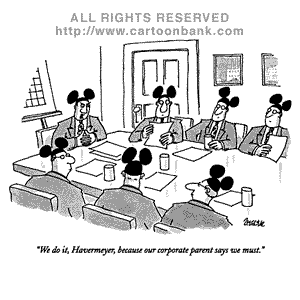
Disney’s got a big task in integrating Pixar – by all accounts, the plan is to keep Pixar independent, or even let the Pixar leadership subsume Disney’s animation department. Standing in the way of this will be countless entrenched Disney minions and the mindset of an acquirer that their ways must be best. Even with the best of intentions these forces can be difficult to overcome.
But Disney – Pixar is the unusual case. The far more common case is where the acquirer simply integrates the acquired company into its operations. There’s lots more I could say about integrations, which is an area I still believe doesn’t get enough attention in the development of deals. But I’m focused at the moment on the “people” issues in an acquisition.
Besides doing acquisitions, I’ve twice been on the receiving end. It’s an interesting and unsettling feeling to be sold – all of the long-term stuff you’re working on becomes, in most cases, moot. You focus instead on the short term, getting the deal done and perhaps helping the buyer with the integration. Everyone at the seller, without exception, wants to know what’s going to happen to their job. Some are simply fearful of losing their jobs; others want to know immediately about opportunities to shine with the new owners; others simply want a severance date so they can move on. There is no end to the amount of worry, gossip and rumor-mongering that goes on at a seller in the weeks after a deal is announced. I think all buyers get this, but have a hard time dealing with it – often because they haven’t really figured out what to do with the people at the time the deal is announced.
In my experience, this causes the buyer to do one of two things with regard to the acquired people: They either clamp down on information or try to put an overly-positive but vague polish on everything. Neither works. When information is restricted, gossip intensifies and people assume the worst. The first time my company was acquired, the buyer went so far as to prohibit us from looking at an employee handbook. The ostensible reason was that our benefits wouldn’t shift to the acquirer plans until the next year, and by then the plans might have changed. This is obviously a trivial concern, and easy to deal with (“here’s our current suite of plans; as you know, by the time you roll onto these plans they may be different”). Instead, my fellow employees assumed the buyer had plans that were far worse than ours, and that’s why they wouldn’t disclose them to us. The senior people felt condescended to, being told we couldn’t answer the specific – and basic – questions our people had about the acquiring company.
Alternatively, the acquirer will repeatedly state their intention to do “best practices” hiring, making everyone at both companies compete for every job so the “best of the best” are staffing the new company. It’s a great goal, but rarely ever done in practice (although I think Sprint and Nextel may have actually implemented it in their merger). If the acquirer doesn’t put a real “best practices” program behind its words, here’s what happens: The acquirer uses the opportunity to push out a few recalcitrant pieces of deadwood, fills in the open spots and a couple of newly-created posts with stars from the acquired company, and then allows the rest of the company to be filled in by its managers. And that’s fine – hell, it’s the acquirer’s prerogative to do whatever it wants with the asset it has just bought. However, if you’ve blown smoke about hiring the “best of the best”, you’re going to have a mightily demoralized employee base when the folks start seeing all of the positions staffed from the acquirer.
Perhaps my experience is shaded by the fact that it has been in telecom, where the people who come with an acquisition are not as important an element as they might be when acquiring a technology company. But you still need people to manage the company through integration, and it’s better to have a pool of reasonably contented potential hires (and customers) than a seething, unproductive mass of resentment. Why not take the time to figure out as much as you can about what’s going to be done with the people? Be candid. Err on the side of providing more information about your company. If you don’t know what’s going to happen with a group of employees, say so, and give them a date by which you’ll know (and meet it). If you know a group won’t have a permanent home, tell them early but also give them parameters on how long their jobs are likely to last. Some HR types may wring their hands over this kind of communication, but it can be managed with little to no risk, and it will greatly benefit your integration while yielding the side benefit of being a decent thing to do.
But Disney – Pixar is the unusual case. The far more common case is where the acquirer simply integrates the acquired company into its operations. There’s lots more I could say about integrations, which is an area I still believe doesn’t get enough attention in the development of deals. But I’m focused at the moment on the “people” issues in an acquisition.
Besides doing acquisitions, I’ve twice been on the receiving end. It’s an interesting and unsettling feeling to be sold – all of the long-term stuff you’re working on becomes, in most cases, moot. You focus instead on the short term, getting the deal done and perhaps helping the buyer with the integration. Everyone at the seller, without exception, wants to know what’s going to happen to their job. Some are simply fearful of losing their jobs; others want to know immediately about opportunities to shine with the new owners; others simply want a severance date so they can move on. There is no end to the amount of worry, gossip and rumor-mongering that goes on at a seller in the weeks after a deal is announced. I think all buyers get this, but have a hard time dealing with it – often because they haven’t really figured out what to do with the people at the time the deal is announced.
In my experience, this causes the buyer to do one of two things with regard to the acquired people: They either clamp down on information or try to put an overly-positive but vague polish on everything. Neither works. When information is restricted, gossip intensifies and people assume the worst. The first time my company was acquired, the buyer went so far as to prohibit us from looking at an employee handbook. The ostensible reason was that our benefits wouldn’t shift to the acquirer plans until the next year, and by then the plans might have changed. This is obviously a trivial concern, and easy to deal with (“here’s our current suite of plans; as you know, by the time you roll onto these plans they may be different”). Instead, my fellow employees assumed the buyer had plans that were far worse than ours, and that’s why they wouldn’t disclose them to us. The senior people felt condescended to, being told we couldn’t answer the specific – and basic – questions our people had about the acquiring company.
Alternatively, the acquirer will repeatedly state their intention to do “best practices” hiring, making everyone at both companies compete for every job so the “best of the best” are staffing the new company. It’s a great goal, but rarely ever done in practice (although I think Sprint and Nextel may have actually implemented it in their merger). If the acquirer doesn’t put a real “best practices” program behind its words, here’s what happens: The acquirer uses the opportunity to push out a few recalcitrant pieces of deadwood, fills in the open spots and a couple of newly-created posts with stars from the acquired company, and then allows the rest of the company to be filled in by its managers. And that’s fine – hell, it’s the acquirer’s prerogative to do whatever it wants with the asset it has just bought. However, if you’ve blown smoke about hiring the “best of the best”, you’re going to have a mightily demoralized employee base when the folks start seeing all of the positions staffed from the acquirer.
Perhaps my experience is shaded by the fact that it has been in telecom, where the people who come with an acquisition are not as important an element as they might be when acquiring a technology company. But you still need people to manage the company through integration, and it’s better to have a pool of reasonably contented potential hires (and customers) than a seething, unproductive mass of resentment. Why not take the time to figure out as much as you can about what’s going to be done with the people? Be candid. Err on the side of providing more information about your company. If you don’t know what’s going to happen with a group of employees, say so, and give them a date by which you’ll know (and meet it). If you know a group won’t have a permanent home, tell them early but also give them parameters on how long their jobs are likely to last. Some HR types may wring their hands over this kind of communication, but it can be managed with little to no risk, and it will greatly benefit your integration while yielding the side benefit of being a decent thing to do.
Thursday, January 26, 2006
Subscribe to:
Posts (Atom)