Blogging has taken a bit of a back seat of late, but a long wait in an airport is always a good cure for that, so here goes. I received several messages back responding to my "lopsided" agreement post with the general theme that it's better to keep agreements as brief as possible.
I'm a big believer in that when it comes to term sheets, and I like it in theory when it comes to definitives, but it's not always easy to achieve. Like haiku, it often takes more time to write a short agreement than a rambling one. In the (large) corporate world, the sheer number of people weighing in will often create a longer agreement, and there's no avoiding long agreements in complex transactions.
However - many commercial transactions can be handled with very brief agreements. In fact, you could write the terms on a cocktail napkin, sign and move forward. I've seen cases where the process of turning an otherwise straightforward transaction into a belt-and-suspenders legal agreement has done more than simply cost time and expense: Deals lost, relationships ruined, and lawsuits created over ambiguities in the "legal" agreement that would never have existed had the parties signed a one-page agreement. Sometimes it's best to just sign a brief letter and move on with your real business.
Thursday, July 13, 2006


Wednesday, June 21, 2006
First Draft Agreements
As a reformed lawyer, I may be more sensitive to how contracts are drafted than some other deal guys. However, a conversation with a former colleague reminded me of a particularly annoying tactic some folks use when sending the initial draft of a definitive agreement - the one-sided, overreaching first draft. It's not something you see every day, but still far too often.
I'm not talking about terms that need to be unilateral or lopsided because of the parties' differing roles, or even terms that are being aggressively negotiated. No, these agreements are laced with terms that favor the drafting party beyond any measure of reason.
Some claim that it makes sense to send over a lopsided contract because (a) the terms may stick and (b) it gives you terms to negotiate back from. I don't find the first point compelling, and the second represents a rather juvenile outlook on negotiating. Sure, lopsided contracts will occasionally work with unsophisticated parties or those you have loads of leverage over. However, in the vast majority of cases they will:
- Piss off your counterparty, harming any useful rapport you may have established
- Make your counterparty dig deeper into the agreement to look for all the other ways you're trying to screw them
- Waste a lot of time as the agreement gets negotiated back to where it should have been in the initial draft
End result: You're back in the same place you would have been had you sent a fairly-written contract, at substantial net expense in time, fees and credibility. You may even lose the deal because of the added delay or trust issues created by your draft.
I'm not talking about terms that need to be unilateral or lopsided because of the parties' differing roles, or even terms that are being aggressively negotiated. No, these agreements are laced with terms that favor the drafting party beyond any measure of reason.
Some claim that it makes sense to send over a lopsided contract because (a) the terms may stick and (b) it gives you terms to negotiate back from. I don't find the first point compelling, and the second represents a rather juvenile outlook on negotiating. Sure, lopsided contracts will occasionally work with unsophisticated parties or those you have loads of leverage over. However, in the vast majority of cases they will:
- Piss off your counterparty, harming any useful rapport you may have established
- Make your counterparty dig deeper into the agreement to look for all the other ways you're trying to screw them
- Waste a lot of time as the agreement gets negotiated back to where it should have been in the initial draft
End result: You're back in the same place you would have been had you sent a fairly-written contract, at substantial net expense in time, fees and credibility. You may even lose the deal because of the added delay or trust issues created by your draft.
Monday, June 12, 2006
Pissing Matches
I spent the first few years after law school as a litigation attorney in a small firm. I learned a lot, and worked with some great folks, several of whom are still good friends. Despite the long time (and career changes) since then, stories like this remind me of what I hated most about litigation - the petty bickering over meaningless crap.
In a negotiation, you can usually find ways to rise above this stuff. In a lawsuit, you may be trapped by the obstinacy of your opposing counsel. What's really amazing here is that both parties to the litigation are companies (OK, insurance companies, but still). You'd think the litigation managers would be wondering why they're getting billed for motions to be filed over such nonsense.
In a negotiation, you can usually find ways to rise above this stuff. In a lawsuit, you may be trapped by the obstinacy of your opposing counsel. What's really amazing here is that both parties to the litigation are companies (OK, insurance companies, but still). You'd think the litigation managers would be wondering why they're getting billed for motions to be filed over such nonsense.
Monday, June 05, 2006
The NPV Trap
Sorry, no link, but the FT ran an article last week on "valuing innovation" that gets right to one fundamental problem with financial analysis - its usefulness varies greatly depending on the maturity of the project. The article focuses on investment decisions in projects and R&D, but the thesis works just as well with M&A.
Probably because I come from a non-financial background, I've always nursed a little rebellious streak when it comes to financial analysis and the pedestal upon which NPV calculations are placed in the corporate world. Sure, I'll use them as much as the next guy, and I am a firm believer that a discounted cash flow analysis is the single best way to assess the value of an operating business. The problem is that such analyses are only as good as the assumptions that go into them.
While future results for mature operations can be estimated with a fair bit of accuracy (or at least conformed to the acquirer's 10 year planning assumptions for modeling purposes), trying to produce a similar DCF model for a 6-person start-up with wonderful but untested technology is an exercise in fiction writing. Yet - who hasn't seen someone trot out an NPV analysis and hold it up as objective truth, despite the fact that the assumptions underlying the analysis might as well have been plucked from a hat?
There can be a powerful tendency to try and view all potential investment via the same lens, and NPV analysis often gets a halo of legitimancy because it is numbers-driven. Sadly, the numbers that come out are no better than the assumptions that go in. The FT article thesis is that companies should use multiple scoring factors in evaluating projects, with greater weight given to financial analysis as the project gets more mature (and hence more amenable to accurate forecasting). In the case of acquisitions, companies need to weigh factors other than just the NPV analysis - strategic fit, customer needs addressed, people issues, scope of potential benefit, etc. Equally important, the NPV analysis should be known for what it is - a very useful tool under the right conditions, but one of diminishing usefulness when it comes to the new and different.
Probably because I come from a non-financial background, I've always nursed a little rebellious streak when it comes to financial analysis and the pedestal upon which NPV calculations are placed in the corporate world. Sure, I'll use them as much as the next guy, and I am a firm believer that a discounted cash flow analysis is the single best way to assess the value of an operating business. The problem is that such analyses are only as good as the assumptions that go into them.
While future results for mature operations can be estimated with a fair bit of accuracy (or at least conformed to the acquirer's 10 year planning assumptions for modeling purposes), trying to produce a similar DCF model for a 6-person start-up with wonderful but untested technology is an exercise in fiction writing. Yet - who hasn't seen someone trot out an NPV analysis and hold it up as objective truth, despite the fact that the assumptions underlying the analysis might as well have been plucked from a hat?
There can be a powerful tendency to try and view all potential investment via the same lens, and NPV analysis often gets a halo of legitimancy because it is numbers-driven. Sadly, the numbers that come out are no better than the assumptions that go in. The FT article thesis is that companies should use multiple scoring factors in evaluating projects, with greater weight given to financial analysis as the project gets more mature (and hence more amenable to accurate forecasting). In the case of acquisitions, companies need to weigh factors other than just the NPV analysis - strategic fit, customer needs addressed, people issues, scope of potential benefit, etc. Equally important, the NPV analysis should be known for what it is - a very useful tool under the right conditions, but one of diminishing usefulness when it comes to the new and different.
Thursday, June 01, 2006
Trademarks and Cease-and-Desist Letters
Great, thoughtful post in Ventureblog regarding the dust-up over the "Web 2.0" trademark registration. As a reformed lawyer, I would take a point made at the end of the post even further - enterprises that allow their counsel to decide when to send cease-and-desist letters are almost always making a mistake.
Why? Even if the use is in the gray area, there's no downside (from a strictly legal perspective) to sending a letter, and such letters are great evidence (again, from a strictly legal perspective) to establishing that you have properly defended your marks. So, if you as the business person bring a question of possibly infringing use to your trademark counsel, the basic legal answer you get back will be to send a cease-and-desist letter. Of course, savvy trademark counsel will walk you through the pros and cons and potential PR and customer pitfalls of taking this approach. Unfortunately, many will simply apply a mechanistic legal test and advise sending the letter.
This can't be the end of your analysis. In all but the most cut-and-dried cases - say, a similarly-sized competitor making an infringing use, or outright stealing/counterfeiting - informal discussions and attempts to resolve amicably must be used prior to dropping the cease-and-desist letter. Such efforts often work, they are cheap, and they can keep your enterprise from encountering something that seems to be repeated as often as the seasons in the corporate world - big companies getting smacked back on the PR front for bullying behavior toward tiny enterprises.
Why? Even if the use is in the gray area, there's no downside (from a strictly legal perspective) to sending a letter, and such letters are great evidence (again, from a strictly legal perspective) to establishing that you have properly defended your marks. So, if you as the business person bring a question of possibly infringing use to your trademark counsel, the basic legal answer you get back will be to send a cease-and-desist letter. Of course, savvy trademark counsel will walk you through the pros and cons and potential PR and customer pitfalls of taking this approach. Unfortunately, many will simply apply a mechanistic legal test and advise sending the letter.
This can't be the end of your analysis. In all but the most cut-and-dried cases - say, a similarly-sized competitor making an infringing use, or outright stealing/counterfeiting - informal discussions and attempts to resolve amicably must be used prior to dropping the cease-and-desist letter. Such efforts often work, they are cheap, and they can keep your enterprise from encountering something that seems to be repeated as often as the seasons in the corporate world - big companies getting smacked back on the PR front for bullying behavior toward tiny enterprises.
Friday, May 26, 2006
More on Kimonos
My antipathy to the phrase "open the kimono" can be traced back to when I first heard it, about 10 years ago. I had recently moved to an in-house legal position and I was meeting with Lucent - recently spun out of AT&T - to try and resolve a commercial dispute that was teetering toward litigation. I don't even recall the particulars, but I vividly remember the counsel for Lucent, a humorless, pinched-face fellow in his mid-50's, saying he was "going to open the kimono." Yes, he was referring to Lucent's confidential data, but the mental image it created was most unpleasant.
Thursday, May 25, 2006
New Favorite Office Book
I just picked up The Dictionary of Corporate Bullshit, which is hilarious and absolutely on point. Taking a cue from Ambrose Bierce's classic The Devil's Dictionary, it offers witty and point-on definitions of corporate buzzwords and standards (e.g., "'Merger:' Source of major freakout mode amongst employees.").
Of course, I read through the more noxious entries with some distress, thinking of how often I have sputtered out hackneyed phrases like "paradigm shift" or "putting a stake in the ground." I am proud to say I have not used "productize", which does not merit entry in the dictionary but should have a special place in corporate-speak hell.
Speaking of which, I was in a meeting this morning discussing exchanges of confidential information where the phrase "drop our shorts" was used. I have to say I like that better than "open the kimono," but all the same I'd rather just talk about "skeletons in the closet."
Of course, I read through the more noxious entries with some distress, thinking of how often I have sputtered out hackneyed phrases like "paradigm shift" or "putting a stake in the ground." I am proud to say I have not used "productize", which does not merit entry in the dictionary but should have a special place in corporate-speak hell.
Speaking of which, I was in a meeting this morning discussing exchanges of confidential information where the phrase "drop our shorts" was used. I have to say I like that better than "open the kimono," but all the same I'd rather just talk about "skeletons in the closet."
Monday, May 15, 2006
Phone Records
I've been following this story about the big telcos turning over call detail records to the NSA with some interest. In the late 90's, when I was general counsel for Cellular One of San Francisco, one responsibility of my department was subpoena compliance, and we faced the same type of question every day.
We received all sorts of subpoenas, civil and criminal, from myriad agencies and private attorneys, seeking everything from invoices to wiretaps. Sorting out what could be provided in response to what kind of process (simple private subpoena to court order) was a daunting task: Different agencies have different rights, and circumstances matter, too. We would sometimes provide records in advance of a warrant or order when a kidnapping was underway, for example.
To make our way through this maze of regulations, we had a thick guidebook, regularly updated, that spelled out exactly what could be done in virtually any set of circumstances. Every telco of any size has a guidebook like this - ours could trace its origins to AT&T's guidebook. Received a warrant by fax from the DEA? ATF is calling saying they've got a subpoena? Santa Clara County Public Defender wants phone records? The procedures were all spelled out, along with the accompanying citations to statute, and my folks who dealt with this stuff on a daily basis were very good at sorting through it. They had great relationships with their counterparts in law enforcement and would only come to me when a very difficult or high-profile call needed to be made.
Of these, the hardest calls to make were those involving exigent circumstances - do you believe what law enforcement is telling you about the circumstances and the reasons they need the information now (rather than after they've provided a warrant), and do you believe they will get you a warrant after the fact? But these questions were measured in minutes or hours - getting a warrant is not difficult or time-consuming where the facts justify it.
The current furor over the records turned over to the NSA falls under the much easier category - law enforcement bullying their way to records they may not be entitled to. You see, despite the complexity of so many agencies being subject to different rules about what can and cannot be provided, there is a simple fallback answer when the request falls in a grey zone - "I'd be happy to comply with your request as soon as you give me a warrant (or court order, for wiretaps)." The beauty of this answer is how much ground it covers. It insulates your company from liability for providing records illegally, and if for some reason you are wrong in asking for the warrant, you get a quick education from law enforcement counsel, who will point you to the exact regulation that provides for access without a warrant. Most of the time, they'll grumble and then go get a warrant or order. Sometimes they just go away, as the NSA ultimately did after being rebuffed by Qwest.
In my view, Qwest did the obvious thing in response to the NSA's request. The surprising thing is that AT&T, Verizon and BellSouth rolled over and gave the NSA these records when the simple expedient of insisting on a court order existed.
We received all sorts of subpoenas, civil and criminal, from myriad agencies and private attorneys, seeking everything from invoices to wiretaps. Sorting out what could be provided in response to what kind of process (simple private subpoena to court order) was a daunting task: Different agencies have different rights, and circumstances matter, too. We would sometimes provide records in advance of a warrant or order when a kidnapping was underway, for example.
To make our way through this maze of regulations, we had a thick guidebook, regularly updated, that spelled out exactly what could be done in virtually any set of circumstances. Every telco of any size has a guidebook like this - ours could trace its origins to AT&T's guidebook. Received a warrant by fax from the DEA? ATF is calling saying they've got a subpoena? Santa Clara County Public Defender wants phone records? The procedures were all spelled out, along with the accompanying citations to statute, and my folks who dealt with this stuff on a daily basis were very good at sorting through it. They had great relationships with their counterparts in law enforcement and would only come to me when a very difficult or high-profile call needed to be made.
Of these, the hardest calls to make were those involving exigent circumstances - do you believe what law enforcement is telling you about the circumstances and the reasons they need the information now (rather than after they've provided a warrant), and do you believe they will get you a warrant after the fact? But these questions were measured in minutes or hours - getting a warrant is not difficult or time-consuming where the facts justify it.
The current furor over the records turned over to the NSA falls under the much easier category - law enforcement bullying their way to records they may not be entitled to. You see, despite the complexity of so many agencies being subject to different rules about what can and cannot be provided, there is a simple fallback answer when the request falls in a grey zone - "I'd be happy to comply with your request as soon as you give me a warrant (or court order, for wiretaps)." The beauty of this answer is how much ground it covers. It insulates your company from liability for providing records illegally, and if for some reason you are wrong in asking for the warrant, you get a quick education from law enforcement counsel, who will point you to the exact regulation that provides for access without a warrant. Most of the time, they'll grumble and then go get a warrant or order. Sometimes they just go away, as the NSA ultimately did after being rebuffed by Qwest.
In my view, Qwest did the obvious thing in response to the NSA's request. The surprising thing is that AT&T, Verizon and BellSouth rolled over and gave the NSA these records when the simple expedient of insisting on a court order existed.
Friday, May 05, 2006
Dread Not
Fascinating study making news today - it seems that feelings of dread are, in rough terms, a kind of pain, and a fair number of people will engage in irrational behavior to alleviate this pain. The experiment itself is sinister: Subjects are told they are going to get an electric shock, and if they wait longer the shock will be less painful. Apparently a decent number of subjects dread the prospect of a shock so much that they are willing to take a more painful shock now in exchange for eliminating the dread of the shock occuring later.
Like most people faced with an unpleasant task, I'd rather get it over with sooner rather than later. Of course, that may have less to do with dread than with the fact that in the real world the pain/unpleasantness is almost always greater the longer one waits to face it. I'm fascinated that, at least for some people, getting rid of the dread as quickly as possible is worth taking more (physical) pain.
Does this translate to decision-making in business? In cases like Enron or WorldCom hope (or hubris, or crookedness) led businesses and their leaders to delay taking the pain until it is too late and the negative impacts had mushroomed. But what about those businesses that ruthlessly weed out uncertainty, say, at the expense of promising new initiatives or technologies with uncertain paybacks or markets? Is this efficiency, or is uncertainty the corporate version of dread?
Like most people faced with an unpleasant task, I'd rather get it over with sooner rather than later. Of course, that may have less to do with dread than with the fact that in the real world the pain/unpleasantness is almost always greater the longer one waits to face it. I'm fascinated that, at least for some people, getting rid of the dread as quickly as possible is worth taking more (physical) pain.
Does this translate to decision-making in business? In cases like Enron or WorldCom hope (or hubris, or crookedness) led businesses and their leaders to delay taking the pain until it is too late and the negative impacts had mushroomed. But what about those businesses that ruthlessly weed out uncertainty, say, at the expense of promising new initiatives or technologies with uncertain paybacks or markets? Is this efficiency, or is uncertainty the corporate version of dread?
Monday, May 01, 2006
Merger-Hostile CEO
Surprising news this morning that Autostrade's CEO, Vito Gamberale, is now opposing the company's acquisition by Spain's Abertis. Surprising not only because you simply don't expect to see such things in any merger, let alone one where the target sells for over $10 billion, but also because Gamberale was publicly touting the deal last week.
What could possibly explain this behavior? It's not unheard of for a board to push for a deal the CEO doesn't like, and that may have been the case here, with the Benetton family controlling a majority of Autostrade. It's certainly odd that Gambarele apparantly did not even know the negotiations were going on until the 11th hour. However, you'd expect owners and CEOs to work these details out before the deal is announced, with the CEO falling in line or leaving. Now Gamberele likely will leave, but only after an ugly public spat. This seems like a worst-case scenario for all concerned - the guys at Abertis have got to be pulling their hair out.
It does bring to mind one aspect of executive compensation that you don't hear much about: Does the absence of a nice equity payout on closing of a merger make company management more hostile to deals that are otherwise in shareholders' interests? In other words, are some executives more concerned about keeping their jobs (or roles) than maximizing shareholder value? I have never witnessed this phenomenon firsthand (although I have seen it in spades among rank-and-file workers), but it would not be a shocker if Gamberale had a different agenda than the Benettons for this reason.
What could possibly explain this behavior? It's not unheard of for a board to push for a deal the CEO doesn't like, and that may have been the case here, with the Benetton family controlling a majority of Autostrade. It's certainly odd that Gambarele apparantly did not even know the negotiations were going on until the 11th hour. However, you'd expect owners and CEOs to work these details out before the deal is announced, with the CEO falling in line or leaving. Now Gamberele likely will leave, but only after an ugly public spat. This seems like a worst-case scenario for all concerned - the guys at Abertis have got to be pulling their hair out.
It does bring to mind one aspect of executive compensation that you don't hear much about: Does the absence of a nice equity payout on closing of a merger make company management more hostile to deals that are otherwise in shareholders' interests? In other words, are some executives more concerned about keeping their jobs (or roles) than maximizing shareholder value? I have never witnessed this phenomenon firsthand (although I have seen it in spades among rank-and-file workers), but it would not be a shocker if Gamberale had a different agenda than the Benettons for this reason.
Friday, April 28, 2006
Cross-Border Fun and Games
I spent the last week or so on vacation in Rome - a great place for unwinding and gaining perspective. During my trip I stayed clear of e-mail (and certainly blogging), but I did watch enough of Sky News to see reports of the "merger of equals" (i.e., takeover) between Spain's Abertis and Italy's Autostrade. The new company will be the world's largest operator of toll roads and airports. It will also be headquartered in Spain.
Predictably enough, Italy's incoming Prodi government was all over the deal, questioning whether the Iberian-centric company would have the proper focus on creating new infrastructure in Italy. Putting aside the utter speciousness of that argument for a moment, I am struck by the continued resistance, in our age of globalization, to cross-border deals. And it's not just leftist coalition governments in Italy: In the last year here in the U.S., we've seen major deals blown on even flimsier grounds - the recent Dubai ports debacle and the attempted takeout of Unocal by China's Cnooc. In all cases the putative buyers are major global companies, traded on global exchanges, answerable to investors spread around the world, and often managed by teams hailing far from the acquiror's corporate HQ. Why the hyper-focus on the national roots of the corporate buyer? Listen to some folks talk and you'd think these guys are the modern equivalent of Viking raiders, lighting our thatched roofs on fire and brutalizing the people.
Governments obviously have a right - and a duty - to vett foreign purchasers and make sure deals don't compromise national security. I can even be somewhat sympathetic to government objections to deals that explicitly harm domestic competitiveness or cost a large number of jobs. There are certain higher bars that a foreign acquiror should legitimately expect to have to clear. However, it seems that you've also got to spend a lot of time sniffing out the more extreme arguments, play devil's advocate like a flag-waver, and in the end make a sober assessment of whether your deal can make it past the mob.
Predictably enough, Italy's incoming Prodi government was all over the deal, questioning whether the Iberian-centric company would have the proper focus on creating new infrastructure in Italy. Putting aside the utter speciousness of that argument for a moment, I am struck by the continued resistance, in our age of globalization, to cross-border deals. And it's not just leftist coalition governments in Italy: In the last year here in the U.S., we've seen major deals blown on even flimsier grounds - the recent Dubai ports debacle and the attempted takeout of Unocal by China's Cnooc. In all cases the putative buyers are major global companies, traded on global exchanges, answerable to investors spread around the world, and often managed by teams hailing far from the acquiror's corporate HQ. Why the hyper-focus on the national roots of the corporate buyer? Listen to some folks talk and you'd think these guys are the modern equivalent of Viking raiders, lighting our thatched roofs on fire and brutalizing the people.
Governments obviously have a right - and a duty - to vett foreign purchasers and make sure deals don't compromise national security. I can even be somewhat sympathetic to government objections to deals that explicitly harm domestic competitiveness or cost a large number of jobs. There are certain higher bars that a foreign acquiror should legitimately expect to have to clear. However, it seems that you've also got to spend a lot of time sniffing out the more extreme arguments, play devil's advocate like a flag-waver, and in the end make a sober assessment of whether your deal can make it past the mob.
Tuesday, April 18, 2006
Gun-Jumping
Sometimes it just doesn't pay to be a tough negotiator - witness Qualcomm's announcement Monday that it is entering into a consent decree with DOJ and paying $1.8M to settle claims of gun jumping in its acquisition of Flarion ("gun jumping" being where the acquiror starts getting a bit too intimate with the seller's business ops before the deal has closed).
While a buyer can't run the acquired business before the deal closes, there's always a healthy negotiation over the amount of control the buyer will exert (via operating covenants written into the acquisition agreement) during the pre-closing period. These covenants are typically designed to ensure that, to the extent possible, the acquired business continues to operate in a straight-and-narrow course until closing. Themes for operating covenants include the permissable amount of new debt, capital expenditue limits, asset sales, etc. - anything that might materially change the nature of what the buyer thought they were buying. However, buyers usually have to stay well clear of anything involving customers and markets, particularly when acquiring a competitor, to avoid the appearance of gun jumping.
Gun jumping is of heightened concern in industries like telecom, where the wait for closing can exceed one year. The long wait obviously increases the operating risk during the pre-closing period, thus ratcheting up the desire to steer the target's course during that period or get a jump on integration. Many M&A lawyers take a very conservative stance on gun jumping, preventing most conversation pre-close on the (not unreasonable) presumption that some business people will jump the gun. Buyers want to get moving; sellers usually want to be compliant - the gun gets jumped.
What's interesting about the Qualcomm news is that the claims don't relate to any over-reaching behavior by Qualcomm executives, but rather the language in the merger agreement itself.
Obviously the size of this fine is not material to Qualcomm or even this deal itself (the $1.8M fine is well less than one-half of one percent of the purchase price). However, I'm sure the threat of this action scuttling or slowing the deal caused many a sleepless night for those involved - and may still, if you are a Qualcomm lawyer.
While a buyer can't run the acquired business before the deal closes, there's always a healthy negotiation over the amount of control the buyer will exert (via operating covenants written into the acquisition agreement) during the pre-closing period. These covenants are typically designed to ensure that, to the extent possible, the acquired business continues to operate in a straight-and-narrow course until closing. Themes for operating covenants include the permissable amount of new debt, capital expenditue limits, asset sales, etc. - anything that might materially change the nature of what the buyer thought they were buying. However, buyers usually have to stay well clear of anything involving customers and markets, particularly when acquiring a competitor, to avoid the appearance of gun jumping.
Gun jumping is of heightened concern in industries like telecom, where the wait for closing can exceed one year. The long wait obviously increases the operating risk during the pre-closing period, thus ratcheting up the desire to steer the target's course during that period or get a jump on integration. Many M&A lawyers take a very conservative stance on gun jumping, preventing most conversation pre-close on the (not unreasonable) presumption that some business people will jump the gun. Buyers want to get moving; sellers usually want to be compliant - the gun gets jumped.
What's interesting about the Qualcomm news is that the claims don't relate to any over-reaching behavior by Qualcomm executives, but rather the language in the merger agreement itself.
Obviously the size of this fine is not material to Qualcomm or even this deal itself (the $1.8M fine is well less than one-half of one percent of the purchase price). However, I'm sure the threat of this action scuttling or slowing the deal caused many a sleepless night for those involved - and may still, if you are a Qualcomm lawyer.
Friday, April 14, 2006
Cougars and the Law
Non-corp dev related, but I noticed this morning that the Oregon Department of Fish and Wildlife is moving forward with an expanded plan to control the state's cougar population. Whereas to date the department has responded only to specific cougar sightings, they now plan to hunt cougars more generally in an effort to control the expanding population. To greatly increase the efficiency of this effort, they plan to use dogs.
Cougar sightings are on the increase out here in the West, and cougar populations have expanded at a time of rapid human population growth in western states. My hometown of Bend, Oregon - set in cougar territory just east of the Cascade mountains - has been one of the fastest-growing communities in the country for the last 20 years. There's little question that this combination leads to an increase in human/cougar interactions, as well as losses of livestock and domestic pets.
My first reaction to the news that state-funded hunters would be culling the cougar population was: Why not expand the cougar season and let private hunters do it? That's a cornerstone of wildlife management, as seasons, hunting rules, fees and limits are constantly adjusted to account for population fluctuations. As it turns out, the department has already done that, expanding the season to 10 months and reducing the tag fees to nominal levels. The problem? Private hunters in Oregon can't use dogs to hunt cougars, thanks to a state initiative passed some years back.
The result of the initiative's passing was a steep climb in the cougar population as hunting success plummeted due to the lack of ability to use dogs. The state tried to offset this growth by expanding the cougar season and reducing tag prices, but now finds itself turning to dogs to keep the population in check. So, the net outcome of the voters' action wasn't to permanently end the hunting of cougars with dogs; it was simply to shift the cost of hunting cougars with dogs from private hunters to the state and its taxpayers. You've got to love the initiative process.
Cougar sightings are on the increase out here in the West, and cougar populations have expanded at a time of rapid human population growth in western states. My hometown of Bend, Oregon - set in cougar territory just east of the Cascade mountains - has been one of the fastest-growing communities in the country for the last 20 years. There's little question that this combination leads to an increase in human/cougar interactions, as well as losses of livestock and domestic pets.
My first reaction to the news that state-funded hunters would be culling the cougar population was: Why not expand the cougar season and let private hunters do it? That's a cornerstone of wildlife management, as seasons, hunting rules, fees and limits are constantly adjusted to account for population fluctuations. As it turns out, the department has already done that, expanding the season to 10 months and reducing the tag fees to nominal levels. The problem? Private hunters in Oregon can't use dogs to hunt cougars, thanks to a state initiative passed some years back.
The result of the initiative's passing was a steep climb in the cougar population as hunting success plummeted due to the lack of ability to use dogs. The state tried to offset this growth by expanding the cougar season and reducing tag prices, but now finds itself turning to dogs to keep the population in check. So, the net outcome of the voters' action wasn't to permanently end the hunting of cougars with dogs; it was simply to shift the cost of hunting cougars with dogs from private hunters to the state and its taxpayers. You've got to love the initiative process.
Thursday, April 13, 2006
My Vodafone Disclaimer
Nice attention from The Deal today. I should mention that when it comes to Vodafone I'm not necessarily partial; I spent several months dealing with them very closely when we were auctioning off AT&T Wireless. I came away from that process deeply impressed with Vodafone's operating efficiency. They just seemed to do everything well, even down to how they conducted diligence and negotiated the merger agreement. And you never saw a more starry-eyed group of swooning senior executives than our folks after the presentations Vodafone made to us for reverse diligence. I sometimes think I might have lost some respect for them had they paid as much for AWE as Cingular did! So - besides the lack of compelling business logic, I also have a more gut-level negative reaction to the prospect of Vodafone being taken apart by Verizon-Telefonica-Blackstone trifecta.
That sale, by the way, was quite the drama. Amir Mirza, a banker at Merrill Lynch (and a helluva guy) has always told me I should write a book about the experience. Now that I've got more than one year's distance from Cingular, I think I may do something like that and serialize the story here. Look for postings titled "The Sale of AT&T Wireless".
That sale, by the way, was quite the drama. Amir Mirza, a banker at Merrill Lynch (and a helluva guy) has always told me I should write a book about the experience. Now that I've got more than one year's distance from Cingular, I think I may do something like that and serialize the story here. Look for postings titled "The Sale of AT&T Wireless".
Monday, April 10, 2006
Vodafone Catching a Bid?
Funny rumor circulating about a potential takeover of Vodafone by Verizon, Telefonica and Blackstone. According to reports, the trio would pay about $168B for Vodafone. Since the press is notorious for not dealing with debt in merger valuation, as an equity valuation this would represent a 20% premium to today's price. Including Vodafone's $22B in long-term debt makes this a $190B deal.
It's an audacious rumor, and the market is having none of it - Vodafone stock has barely moved today. Why should it? This one of the world's biggest companies, and one of the best managed. While Vodafone has run into a rough patch in the last year, this hardly seems like the time for Vodafone shareowners to cut and run.
But what of the putative acquirors? Could it really make sense to break up this global powerhouse, built on the back of dozens of mergers over the last 10 years? I'd guess that it's easy for Blackstone, since as the glue holding this deal together they would get the pieces of Vodafone most easily grown and re-sold. It's harder for Telefonica - while it gets them more solidly into Europe, they seem to have ample room for growth in their LatAm markets without needing an expensive acquisition like this. Telefonica is also still working through the integration of O2, acquired just last year. Still, it's enormously gratifying to the corporate ego to smack a big competitor down, and that factor can't be entirely ignored.
My guess is that this rumor is a trial balloon floated by Verizon's bankers. Within the next year or so, Verizon is going to have to pony up $50B+ for Vodafone's minority interest in Verizon Wireless. There is probably a very credible model floating around Verizon's HQ showing that buying and breaking up Vodafone is a better deal for Verizon than simply paying a ton of cash for outright ownership of Verizon Wireless.
It would be a bold play (to put it mildly), but I'd be surprised to see it happen. Besides the obvious execution risk, there's the fact that, rightly or wrongly, domestic investors don't give U.S. companies adequate credit for foreign operations. This doesn't make much difference for companies with relatively low costs to enter and manage new markets, but it creates a big headwind for teleco companies having to invest billions in licenses and capital to build and maintain networks. While obtaining Verizon's UK assets may be accretive to Verizon compared with buying Vodafone out of the U.S., it would need to do so in a way that accounted for U.S. investors' tendency to treat foreign assets as non-core. Even with Vodafone stock mired in a slump, it's hard to see how this could pencil out to being anything more than marginally better than the alternative of biting down hard and paying Vodafone to walk from Verizon Wireless.
It's an audacious rumor, and the market is having none of it - Vodafone stock has barely moved today. Why should it? This one of the world's biggest companies, and one of the best managed. While Vodafone has run into a rough patch in the last year, this hardly seems like the time for Vodafone shareowners to cut and run.
But what of the putative acquirors? Could it really make sense to break up this global powerhouse, built on the back of dozens of mergers over the last 10 years? I'd guess that it's easy for Blackstone, since as the glue holding this deal together they would get the pieces of Vodafone most easily grown and re-sold. It's harder for Telefonica - while it gets them more solidly into Europe, they seem to have ample room for growth in their LatAm markets without needing an expensive acquisition like this. Telefonica is also still working through the integration of O2, acquired just last year. Still, it's enormously gratifying to the corporate ego to smack a big competitor down, and that factor can't be entirely ignored.
My guess is that this rumor is a trial balloon floated by Verizon's bankers. Within the next year or so, Verizon is going to have to pony up $50B+ for Vodafone's minority interest in Verizon Wireless. There is probably a very credible model floating around Verizon's HQ showing that buying and breaking up Vodafone is a better deal for Verizon than simply paying a ton of cash for outright ownership of Verizon Wireless.
It would be a bold play (to put it mildly), but I'd be surprised to see it happen. Besides the obvious execution risk, there's the fact that, rightly or wrongly, domestic investors don't give U.S. companies adequate credit for foreign operations. This doesn't make much difference for companies with relatively low costs to enter and manage new markets, but it creates a big headwind for teleco companies having to invest billions in licenses and capital to build and maintain networks. While obtaining Verizon's UK assets may be accretive to Verizon compared with buying Vodafone out of the U.S., it would need to do so in a way that accounted for U.S. investors' tendency to treat foreign assets as non-core. Even with Vodafone stock mired in a slump, it's hard to see how this could pencil out to being anything more than marginally better than the alternative of biting down hard and paying Vodafone to walk from Verizon Wireless.
Monday, April 03, 2006
Alcatel-Lucent
While the Alcatel-Lucent tie-up makes a lot of sense on paper, creating an integrated company in high-tech manufacturing is tricky business. Throw in the cross-border and cultural compatibility issues, and this looks to be at least as steep a climb as the HP-Compaq merger. I hope it works out better than that, but both companies are going to have to be very, very focused on executing their integration plan.
I know, that seems obvious - every company going through a merger should be focused on merger integration. However, big companies can't always get out of their own ways, and when the realities of quarterly results, competition and internecine fighting start kicking in, that focus can be lost. Some consolidating mergers can absorb these effects and still succeed - this one can't.
I know, that seems obvious - every company going through a merger should be focused on merger integration. However, big companies can't always get out of their own ways, and when the realities of quarterly results, competition and internecine fighting start kicking in, that focus can be lost. Some consolidating mergers can absorb these effects and still succeed - this one can't.
Friday, March 31, 2006
The "Managerial Administration"
The Bush administration has often prided itself on its "managerial" nature, and I tend to agree - it has shown many of the aspects of a (poorly run) business.
Latest case in point - the appointment of Josh Bolten as Chief of Staff. As I've harped on before, one problem with corporate decision-making is a tendency by staffers to say "yes" to senior management (and a corresponding desire by senior managers to want to hear it). A related problem is a lack of diversity of viewpoints: Even if open discussion is encouraged, too much insularity precludes new ideas from getting in. The Bush administration appears to have both problems, and responding to recent crises by appointing yet another insider shows yet again the inability of this poorly-managed enterprise to right itself.
Of course, in the corporate world we would expect a business run like this to quickly fail - here we have to wait for the next election.
Latest case in point - the appointment of Josh Bolten as Chief of Staff. As I've harped on before, one problem with corporate decision-making is a tendency by staffers to say "yes" to senior management (and a corresponding desire by senior managers to want to hear it). A related problem is a lack of diversity of viewpoints: Even if open discussion is encouraged, too much insularity precludes new ideas from getting in. The Bush administration appears to have both problems, and responding to recent crises by appointing yet another insider shows yet again the inability of this poorly-managed enterprise to right itself.
Of course, in the corporate world we would expect a business run like this to quickly fail - here we have to wait for the next election.
Thursday, March 30, 2006
Merger Success
Booz Allen is now saying that the merger failure rate is lower than the two-thirds number trumpeted by Booz (and others) in years past. One of things they point to is the increase in consolidating deals, which - at least in theory - should be likelier to succeed than deals involving new lines of business.
These conclusions are anecdotal, although we may see some data to back it up in the next year or so. Still, seems like a lot of the consolidating deals I've seen (and the one I lived through) in the last couple of years have been at very full prices.
If by "failure" you mean selling the acquired company for a fraction of the purchase price several years later, I agree that you won't see much of that from consolidating acquirors. However, if you define "failure" as a merger failing to meet the IRR assumptions that led to its approval, the high prices paid of late lead me to believe the numbers really haven't changed much.
These conclusions are anecdotal, although we may see some data to back it up in the next year or so. Still, seems like a lot of the consolidating deals I've seen (and the one I lived through) in the last couple of years have been at very full prices.
If by "failure" you mean selling the acquired company for a fraction of the purchase price several years later, I agree that you won't see much of that from consolidating acquirors. However, if you define "failure" as a merger failing to meet the IRR assumptions that led to its approval, the high prices paid of late lead me to believe the numbers really haven't changed much.
Wednesday, March 29, 2006
Dealmaking Balance
Interesting comment on dealmaking, sadly posted anonymously, which I'll quote in part:
Amen, brother! I'm probably on the aggressive side when it comes to dealmaking - when I see value, I want to get something done, and fast. Few things are as frustrating as dealing with counterparties who are bogged down by bureaucracy or fear. But - inside your organization, deal advocacy has to be positioned correctly. It's great to be the guy who focuses on shareholder value and zealously pursues deals that enhance such value, while being up front about the risks and challenges. It's not so good to be the "deal cheerleader" on every potential deal that comes in the door, and gloss over or omit the messy bits.
As for opening moves, no question they serve you well as long as they are reasonable. I always like making the opening offer. Although it involves more uncertainty, over time I believe making the opening offer yields better results by setting the stage for the deal and allowing me to push the timing and process for getting the deal done. However, in my experience playing the tough guy and making an outrageous opening proposal is worse than not making a proposal at all. At best, the other party will treat you as if you didn't even make a proposal. At worst, you'll really need to do the deal, and you'll have to waffle your way to a reasonable position, your credibility shot to hell. There's just no percentage in doing that.
Good deal making requires balance. In my opinion, the biggest hurdle to getting deals done is either a tendency to be overly conservative or too much machismo.
Point 1) . . . far too often apathy and professional butt covering lead to missed opportunities.
Pont 2) . . . we should always strive to make the appropriate opening move . . . making the opening move is often the most difficult part of doing deals but being a tough SOB is not the same thing as being a good deal maker.
Amen, brother! I'm probably on the aggressive side when it comes to dealmaking - when I see value, I want to get something done, and fast. Few things are as frustrating as dealing with counterparties who are bogged down by bureaucracy or fear. But - inside your organization, deal advocacy has to be positioned correctly. It's great to be the guy who focuses on shareholder value and zealously pursues deals that enhance such value, while being up front about the risks and challenges. It's not so good to be the "deal cheerleader" on every potential deal that comes in the door, and gloss over or omit the messy bits.
As for opening moves, no question they serve you well as long as they are reasonable. I always like making the opening offer. Although it involves more uncertainty, over time I believe making the opening offer yields better results by setting the stage for the deal and allowing me to push the timing and process for getting the deal done. However, in my experience playing the tough guy and making an outrageous opening proposal is worse than not making a proposal at all. At best, the other party will treat you as if you didn't even make a proposal. At worst, you'll really need to do the deal, and you'll have to waffle your way to a reasonable position, your credibility shot to hell. There's just no percentage in doing that.
Monday, March 27, 2006
Merger Woes
Nothing relevatory here, but nice high-level list of some of the mistakes that can keep an acquiror from realizing value from an acquisition.
And speaking of value not realized, I had to chuckle at the news that Skype is now being sued over the IP acquired by Ebay in picking up Skype. I figured that Skype was primarily a marketing/sub acquisition play by Ebay, but some tried to convince me that the deal was primarily about Skype's technology. Let's hope not.
The lawsuit may be a whole lot of nothing, and the fact that the causes of action are styled as RICO claims makes me think there's more hyperbole than merit to them. But with questions over the transferability of the technology and the Skype founders' former business dealings, I'd say the Ebay/Skype deal isn't shaping up to be a nominee for the M&A hall of fame.
And speaking of value not realized, I had to chuckle at the news that Skype is now being sued over the IP acquired by Ebay in picking up Skype. I figured that Skype was primarily a marketing/sub acquisition play by Ebay, but some tried to convince me that the deal was primarily about Skype's technology. Let's hope not.
The lawsuit may be a whole lot of nothing, and the fact that the causes of action are styled as RICO claims makes me think there's more hyperbole than merit to them. But with questions over the transferability of the technology and the Skype founders' former business dealings, I'd say the Ebay/Skype deal isn't shaping up to be a nominee for the M&A hall of fame.
Friday, March 24, 2006
Playing Devil's Advocate
Equity Private notes that in her firm, two team members are assigned to each potential deal as "pro" and "risk" advocates - an excellent example of a formalized way of maximizing input on a decision.
Most corporations do this in a similar, if less formal way, with the CFO playing the role of the "risk" advocate. As I've stressed in earlier posts, corp dev types can't afford to let this happen - you need to internalize both the "pro" and the "risk" mindsets (even if it means taking on a formal process). If you only present the good news, and your CFO has to continuously be the one to ferret out the risks, your credibility will be gone in a hurry.
In private equity, there's more allowance given for aggressively pushing a deal. After all, putting the investor's money to work via acquisitions is the name of the game, and the only real question is whether your deal is as pretty as the other deals.
In a corporation, senior management will be suspicious of deals being pushed too aggressively, especially if there's any whiff that important issues are being glossed over in the rush for approval. Senior leaders certainly care about the IRR of your deal relative to other potential investments, and, like in private equity, they also care about the risk that this IRR won't be realized. However, they will also care about integration and organic growth, subjects not typically of concern to a private equity investment committee (except in cases where the target is to be integrated into another portfolio company). As a consequence, you may have a lovely deal that sparkles in all the right ways, but if you haven't objectively addressed the integration risks and the build/buy analysis up front, you may well see it leave the investment committee in tatters.
Most corporations do this in a similar, if less formal way, with the CFO playing the role of the "risk" advocate. As I've stressed in earlier posts, corp dev types can't afford to let this happen - you need to internalize both the "pro" and the "risk" mindsets (even if it means taking on a formal process). If you only present the good news, and your CFO has to continuously be the one to ferret out the risks, your credibility will be gone in a hurry.
In private equity, there's more allowance given for aggressively pushing a deal. After all, putting the investor's money to work via acquisitions is the name of the game, and the only real question is whether your deal is as pretty as the other deals.
In a corporation, senior management will be suspicious of deals being pushed too aggressively, especially if there's any whiff that important issues are being glossed over in the rush for approval. Senior leaders certainly care about the IRR of your deal relative to other potential investments, and, like in private equity, they also care about the risk that this IRR won't be realized. However, they will also care about integration and organic growth, subjects not typically of concern to a private equity investment committee (except in cases where the target is to be integrated into another portfolio company). As a consequence, you may have a lovely deal that sparkles in all the right ways, but if you haven't objectively addressed the integration risks and the build/buy analysis up front, you may well see it leave the investment committee in tatters.
Tuesday, March 21, 2006
Trying "No" for an Answer
One theme of my last post is a problem endemic to many large corporations – the tendency of employees to fear offering different points of view, and the negative impact this has on decision-making. This subject, covered in a chapter in James Surowiecki’s excellent book, The Wisdom of Crowds, now has a full book devoted to it – Michael Roberto’s Why Great Leaders Don't Take Yes for an Answer: Managing for Conflict and Consensus (see my new "Recommended Reading" sidebar for thumbnail cover photos and links).
Let’s face it – the very existence of hierarchy stifles dissenting voices. Absent any other factors, most employees will – at a minimum – be cautious in expressing differing opinions, new ideas and bad news to the person with control over their paycheck. Add a little managerial ego and that caution will turn into reticence to do anything but nod along with the powers that be.
What about senior managers? Aren't hard-charging, Type-A folks above such caution? Not in my experience. I've worked in companies that welcome debate and conflicting views (including Clearwire) and several very large companies that did not. In the conflict-adverse companies, the greater willingness of senior folks to speak their mind was usually offset by the greater ego and unwillingness to hear dissent possessed by their C-level bosses.
There’s no question that properly-channeled conflict and debate will yield the best decisions, but most organizations have a hard time encouraging this kind of healthy debate. Instead, conflict is often repressed until it explodes into personal attacks, happens too late to change a decision, is conducted passive-aggressively, or all of the above. Leaders in an organization need to be hyper-aware of the things they do to stifle input, and come up with ways to encourage openness and not “punish” those who contribute different or unpopular opinions.
Note that this does not mean giving slack to whiners – not all input is equally valuable, and habitual naysayers are no better than yes-men. Most importantly, the whole team has to get behind the decision once it is made. Giving employees license to be candid should never be confused with giving them license to contribute less than their all once the course is set.
So what can leaders do to encourage openness? Roberto suggests actively seeking dissent by soliciting it directly, having staff role-play adversaries, or even appointing someone as devil’s advocate on a proposal. While the success of such formal steps will depend on the situation, every manager should be looking for opportunities to overcome the inherent bias amongst their employees toward clamming up.
Let’s face it – the very existence of hierarchy stifles dissenting voices. Absent any other factors, most employees will – at a minimum – be cautious in expressing differing opinions, new ideas and bad news to the person with control over their paycheck. Add a little managerial ego and that caution will turn into reticence to do anything but nod along with the powers that be.
What about senior managers? Aren't hard-charging, Type-A folks above such caution? Not in my experience. I've worked in companies that welcome debate and conflicting views (including Clearwire) and several very large companies that did not. In the conflict-adverse companies, the greater willingness of senior folks to speak their mind was usually offset by the greater ego and unwillingness to hear dissent possessed by their C-level bosses.
There’s no question that properly-channeled conflict and debate will yield the best decisions, but most organizations have a hard time encouraging this kind of healthy debate. Instead, conflict is often repressed until it explodes into personal attacks, happens too late to change a decision, is conducted passive-aggressively, or all of the above. Leaders in an organization need to be hyper-aware of the things they do to stifle input, and come up with ways to encourage openness and not “punish” those who contribute different or unpopular opinions.
Note that this does not mean giving slack to whiners – not all input is equally valuable, and habitual naysayers are no better than yes-men. Most importantly, the whole team has to get behind the decision once it is made. Giving employees license to be candid should never be confused with giving them license to contribute less than their all once the course is set.
So what can leaders do to encourage openness? Roberto suggests actively seeking dissent by soliciting it directly, having staff role-play adversaries, or even appointing someone as devil’s advocate on a proposal. While the success of such formal steps will depend on the situation, every manager should be looking for opportunities to overcome the inherent bias amongst their employees toward clamming up.
Monday, March 13, 2006
Managing By Fear
The Financial Times ran a column (subscription req’d) by Lucy Kellaway this morning extolling the virtues of “scariness” in managers. Some of the advice for managers who don’t think they’re scary enough, or feel conditioned by years of coddling their employees? Invade personal space. Shout. Make up a position and stick to it.
Kellaway is of course being satirical in her so-dry, is-this-really-her-opinion? kind of way. But as readers of Martin Lukes know, Kellaway is dead-on in skewering the nascent idiocies of corporate life, and one trend that seems to be percolating is the “death of mentoring” and the benefits of leading through fear. There have always been managers like this, and in some settings they may even be effective. The problem is that so few managers are able to straddle the line between demanding peak performance and maintaining high levels of employee loyalty and creativity. Too much fear, and your employees will certainly be motivated, but they won’t bring their best work or critical ideas. The consequences of being shot down aren’t worth taking the risk. Anyone who has spent any time at all working with top level management in a large corporation will have witnessed the dynamic of senior level bullying shortening – or eliminating – healthy debate.
Conversely, the kind-hearted, mentoring manager will engender great loyalty among his or her people. Unfortunately, without a bit of scariness – or at least a sense of accountability and high expectations – even highly-motivated employees may not do their best. The organization will be a haven for slackers, and resentment will set in among the high performers.
Despite these drawbacks to the "soft" style of managing, I hope Kellaway hasn't spotted a truly emerging trend in dispensing with understanding and involvement in the workplace. The best managers are able to maintain high expectations by staying on top of the business and the work being done, but also engender employee loyalty by welcoming ideas and providing feedback and recognition. I don’t think it’s an easy balance to achieve, but those who make it work get phenomenal results.
Kellaway is of course being satirical in her so-dry, is-this-really-her-opinion? kind of way. But as readers of Martin Lukes know, Kellaway is dead-on in skewering the nascent idiocies of corporate life, and one trend that seems to be percolating is the “death of mentoring” and the benefits of leading through fear. There have always been managers like this, and in some settings they may even be effective. The problem is that so few managers are able to straddle the line between demanding peak performance and maintaining high levels of employee loyalty and creativity. Too much fear, and your employees will certainly be motivated, but they won’t bring their best work or critical ideas. The consequences of being shot down aren’t worth taking the risk. Anyone who has spent any time at all working with top level management in a large corporation will have witnessed the dynamic of senior level bullying shortening – or eliminating – healthy debate.
Conversely, the kind-hearted, mentoring manager will engender great loyalty among his or her people. Unfortunately, without a bit of scariness – or at least a sense of accountability and high expectations – even highly-motivated employees may not do their best. The organization will be a haven for slackers, and resentment will set in among the high performers.
Despite these drawbacks to the "soft" style of managing, I hope Kellaway hasn't spotted a truly emerging trend in dispensing with understanding and involvement in the workplace. The best managers are able to maintain high expectations by staying on top of the business and the work being done, but also engender employee loyalty by welcoming ideas and providing feedback and recognition. I don’t think it’s an easy balance to achieve, but those who make it work get phenomenal results.
Thursday, March 09, 2006
AT&T - BellSouth MAC
Although unlikely to ever be at the center of a J&J-Guidant-like merger termination drama, I figured the MAC clause in the AT&T-BellSouth merger might be interesting. Here it is, courtesy of the filing at Edgar:
(ii) the term "Company Material Adverse Effect" means
(x) an effect that would prevent or materially delay or impair the ability of the Company to consummate the Merger or (y) a material adverse effect on the financial condition, properties, assets, liabilities, business or results of operations of the Company and its Subsidiaries, including its interest in Cingular, YP.com and their respective Subsidiaries, taken as a whole, excluding any such effect resulting from or arising in connection with changes or conditions (A) generally affecting (I) the United States economy or financial or securities markets, (II) political conditions in the United States or (III) the United States telecommunications industry or any generally recognized business segment of such industry, (B) generally affecting the telecommunications industry (or any generally recognized business segment of such industry) in the Company Region, taken as a whole, (C) resulting from any hurricane, earthquake, or other natural disasters in the Company Region, (D) resulting from the execution, announcement or performance of this Agreement, or (E) resulting from or arising in connection with the financial condition, properties, assets, liabilities, business or results of operations of Cingular, YP.com or any of their respective Subsidiaries; and (iii) the "Company Region" means the states of Alabama, Florida, Georgia, Kentucky, Louisiana, Mississippi, North Carolina, South Carolina and Tennessee.
This is pretty straightforward (the AT&T MAC clause mirrors this, only with different regions), and obviously doesn't provide a lot of room to exercise. The interesting part is that problems at Cingular - which is at the center of this deal - can't be the cause of a MAC, no matter how bad such problems might be. Furthermore, problems at the non-Cingular parts of BLS have to be measured against the entire BLS entity in determining if a MAC has occurred. Since Cingular represents something like 60-70% of overall BLS revenue (and growing), problems in the BLS business would have to be awfully dire to constitute a MAC.
Knowing the lawyers involved, I'm quite sure a lot of time and energy went into negotiating this clause, but it's something BLS absolutely had to have (and it's only fair they got it, since AT&T owns 60% of Cingular and effectively runs it already). Closing risk isn't always a major factor in mergers, particularly in small deals with no real regulatory conditions. Here, where closing will take 12-15 months and countless hours spent dealing with the DOJ and FCC, BLS needed to mitigate as much closing risk as possible. Looks like they did so in the MAC at least.
(ii) the term "Company Material Adverse Effect" means
(x) an effect that would prevent or materially delay or impair the ability of the Company to consummate the Merger or (y) a material adverse effect on the financial condition, properties, assets, liabilities, business or results of operations of the Company and its Subsidiaries, including its interest in Cingular, YP.com and their respective Subsidiaries, taken as a whole, excluding any such effect resulting from or arising in connection with changes or conditions (A) generally affecting (I) the United States economy or financial or securities markets, (II) political conditions in the United States or (III) the United States telecommunications industry or any generally recognized business segment of such industry, (B) generally affecting the telecommunications industry (or any generally recognized business segment of such industry) in the Company Region, taken as a whole, (C) resulting from any hurricane, earthquake, or other natural disasters in the Company Region, (D) resulting from the execution, announcement or performance of this Agreement, or (E) resulting from or arising in connection with the financial condition, properties, assets, liabilities, business or results of operations of Cingular, YP.com or any of their respective Subsidiaries; and (iii) the "Company Region" means the states of Alabama, Florida, Georgia, Kentucky, Louisiana, Mississippi, North Carolina, South Carolina and Tennessee.
This is pretty straightforward (the AT&T MAC clause mirrors this, only with different regions), and obviously doesn't provide a lot of room to exercise. The interesting part is that problems at Cingular - which is at the center of this deal - can't be the cause of a MAC, no matter how bad such problems might be. Furthermore, problems at the non-Cingular parts of BLS have to be measured against the entire BLS entity in determining if a MAC has occurred. Since Cingular represents something like 60-70% of overall BLS revenue (and growing), problems in the BLS business would have to be awfully dire to constitute a MAC.
Knowing the lawyers involved, I'm quite sure a lot of time and energy went into negotiating this clause, but it's something BLS absolutely had to have (and it's only fair they got it, since AT&T owns 60% of Cingular and effectively runs it already). Closing risk isn't always a major factor in mergers, particularly in small deals with no real regulatory conditions. Here, where closing will take 12-15 months and countless hours spent dealing with the DOJ and FCC, BLS needed to mitigate as much closing risk as possible. Looks like they did so in the MAC at least.
Monday, March 06, 2006
AT&T - BellSouth
So SBC - newly re-named AT&T - has bought BellSouth for $84B. While certainly not a shocker, I am a little surprised at how fast it happened, given that SBC is still in the re-branding campaign it launched after closing the acquisition of AT&T last fall. Wayne Watts, SBC's primary M&A guy, has now done something like $150B in transactions in the last two years - way to go, Wayne!
While there will be lots of handwringing by consumer advocates in the months ahead over this deal, there's no question it will meet with regulatory approval. AT&T and BLS don't have a lot of overlapping markets, and in the primary growth engine - Cingular - there is obviously no overlap. Plus, those guys in San Antonio are hardly neophytes or shrinking violets in getting deals like this through the sausage-making approval process at Justice and the FCC.
Most amusing to me is that the Cingular name will be gone, reborn as AT&T Wireless (this news comes less than 15 months after Cingular finished rebranding all of the AT&T Wireless stores). And here I thought that entry on my resume was going to fade into oblivion!
While there will be lots of handwringing by consumer advocates in the months ahead over this deal, there's no question it will meet with regulatory approval. AT&T and BLS don't have a lot of overlapping markets, and in the primary growth engine - Cingular - there is obviously no overlap. Plus, those guys in San Antonio are hardly neophytes or shrinking violets in getting deals like this through the sausage-making approval process at Justice and the FCC.
Most amusing to me is that the Cingular name will be gone, reborn as AT&T Wireless (this news comes less than 15 months after Cingular finished rebranding all of the AT&T Wireless stores). And here I thought that entry on my resume was going to fade into oblivion!
Wednesday, March 01, 2006
Rights of First Refusal - Bad for the Holder?
Intriguing article from Harvard Business School regarding rights of first refusal (or ROFRs as we corporate tools call them). For those who don't typically deal with ROFRs, they feature prominently in leases, joint ventures, distribution deals, etc. The central thesis of the article is that ROFRs can run to the detriment of the holder.
Huh? Aren't you always better off having a ROFR than not having one? Well, yeah, you are, except that not all ROFRs are created equally. A typical ROFR allows the holder to always move last. I don't think there's any debate that such a right is good to have. The authors, however, focus on what they call "Before and After" ROFRs, which allow the asset holder to set a price ceiling beyond which the asset can be transferred without being subject to the ROFR. While an arrangement like this is clearly inferior to a straightforward ROFR, it's not inherently bad - it won't always work against the holder, and at worst the holder is in the same place they'd be if they didn't have the ROFR.
The bigger point, however, is that you've got to sweat the details in your deals. You can't glaze over when you see the title header for "Right of First Refusal" (or Termination, or Indemnity, or Dispute Resolution, etc . . .). You've got to think through how these provisions will work mechanically if ever exercised, and make sure you're happy with the process. These details are often left to the lawyers; that can be a costly mistake.
Huh? Aren't you always better off having a ROFR than not having one? Well, yeah, you are, except that not all ROFRs are created equally. A typical ROFR allows the holder to always move last. I don't think there's any debate that such a right is good to have. The authors, however, focus on what they call "Before and After" ROFRs, which allow the asset holder to set a price ceiling beyond which the asset can be transferred without being subject to the ROFR. While an arrangement like this is clearly inferior to a straightforward ROFR, it's not inherently bad - it won't always work against the holder, and at worst the holder is in the same place they'd be if they didn't have the ROFR.
The bigger point, however, is that you've got to sweat the details in your deals. You can't glaze over when you see the title header for "Right of First Refusal" (or Termination, or Indemnity, or Dispute Resolution, etc . . .). You've got to think through how these provisions will work mechanically if ever exercised, and make sure you're happy with the process. These details are often left to the lawyers; that can be a costly mistake.
Tuesday, February 28, 2006
DCF Models
Good and snarky post re deal making on a new private equity focused blog, “Going Private.” I like the explanation for modeling discounted cash flow, which I believe is still the gold standard for valuing any operating business. Comps are interesting, but really just as a point of reference or sanity check. I’m fortunate in never having had to construct a DCF model, but I’ve spent enough time pulling apart and tweaking them (or, more accurately, standing over my analyst’s shoulder and saying things like: “What if we assume we lose two-thirds of the customers we acquire when we force them to change rate plans?”) to know how useful they are in analyzing how an acquired business can fit into its new corporate collective. But there are two important rules corporate development types need to keep in mind when developing DCF models:
1. The model must mirror the inputs in your company’s long-term planning model, no matter how ridiculous.
2. Any deviations from rule #1 must be very strongly supported. Rest assured that your CFO will run your model by the planning trolls, and you will be asked to explain all major differences.
Any acquisition will have deviations, particularly in the first couple of years, and they are easy to explain if you are prepared. Just don’t get put in a position where you have to explain why your proposed acquisition is supposed to be generating margins 500 bp higher than the core business 8 years post-integration.
Anyway, I’m sure at some point the anonymous author of Going Private will want to own up – there’s some good (and funny) writing there. I particularly like this brutal assessment of Guy Kawasaki’s blog – ouch!
1. The model must mirror the inputs in your company’s long-term planning model, no matter how ridiculous.
2. Any deviations from rule #1 must be very strongly supported. Rest assured that your CFO will run your model by the planning trolls, and you will be asked to explain all major differences.
Any acquisition will have deviations, particularly in the first couple of years, and they are easy to explain if you are prepared. Just don’t get put in a position where you have to explain why your proposed acquisition is supposed to be generating margins 500 bp higher than the core business 8 years post-integration.
Anyway, I’m sure at some point the anonymous author of Going Private will want to own up – there’s some good (and funny) writing there. I particularly like this brutal assessment of Guy Kawasaki’s blog – ouch!
Monday, February 27, 2006
Get Your MoCo On
Another godawful term has popped up from nowhere to near-ubiquity in the wireless biz - "MoCo", short for "Mobile Content." It's not like the industry needed another acronym or abbreviated name; Newton's Telecom Dictionary is already on its 21st edition, and must weigh over 2 pounds.
Hopefully "MoCo" will die from overuse. I've already seen several references to "MoCo content" - a sure sign that the term's jaunty friendliness is getting ahead of its meaning.
Hopefully "MoCo" will die from overuse. I've already seen several references to "MoCo content" - a sure sign that the term's jaunty friendliness is getting ahead of its meaning.
Sunday, February 19, 2006
Chaos and Opportunity
I’m not sure what’s got me thinking so much about the employee impacts of M&A lately – maybe it’s all the stories I hear whenever I get together with my former colleagues who are still at Cingular. As I’ve posted before, a merger is a tough thing to go through, particularly if a lot of the work you do is forward-looking. Of course, the flip side is that – as with any corporate situation involving wholesale change – there are often new opportunities amidst the chaos.
While senior people are likeliest to move on to other companies, and junior people may not feel they have access to these opportunities, those in the middle should be looking for every way to use the merger as an avenue to a bigger role. Regardless of level, being proactive is critical. It’s fine to grieve for your old company and the way things were, but don’t give in to the endless grousing that many in the acquired company give in to. Check out the terrain of the new company and start talking to people – positively – about what you can contribute. You’ll quickly find out whether there are golden opportunities or you should run fleeing for the door. Either way, you’re far better off than if you sat back morosely and waited for a pink slip.
Here’s a method I learned quite some ago from an employee of mine: I’d taken over her 10-person group, and she knew I would need to lay off half the group, including her. Instead of sulking or delaying, she came right out with it, acknowledging the reality and offering suggestions for the new staffing plan. She also asked that we pick a date for her to be laid off. Because she did this in our first or second meeting, she was able to get a date nearly four months out – which was probably 3 months more notice than she would have had if she had simply ignored the issue and waited for me to finalize a staffing plan and lay her off. This gave her plenty of time to ramp her job search up and find something new by the time her layoff date arrived. In fact, with luxury of extra time, she was able to find another job in the company, saving me the severance expense!
From almost any manager’s perspective, an employee this proactive is an enormous relief. As a manager, you never know how a termination discussion is going to turn out, or what kind of performance you’re going to get leading up to the termination. Instead, you’ve got an employee offering their professional best in return for some certainty on when they’ll be let go. It doesn’t involve more cost to the company, because you’re not delaying a layoff date – you’re simply providing more notice. It’s a brilliant solution for all involved.
Even if it’s not certain that your position will be eliminated, it’s still a great idea to be proactive with your new managers. If you really want out, it will maximize your chances of getting out on your timetable. If you want to stay, it’s a great way to display your professionalism and interest in staying with the new company. I’ve done this both times my company was acquired – once when I wanted to stay, and once when I wanted to leave – and it worked beautifully both times.
While senior people are likeliest to move on to other companies, and junior people may not feel they have access to these opportunities, those in the middle should be looking for every way to use the merger as an avenue to a bigger role. Regardless of level, being proactive is critical. It’s fine to grieve for your old company and the way things were, but don’t give in to the endless grousing that many in the acquired company give in to. Check out the terrain of the new company and start talking to people – positively – about what you can contribute. You’ll quickly find out whether there are golden opportunities or you should run fleeing for the door. Either way, you’re far better off than if you sat back morosely and waited for a pink slip.
Here’s a method I learned quite some ago from an employee of mine: I’d taken over her 10-person group, and she knew I would need to lay off half the group, including her. Instead of sulking or delaying, she came right out with it, acknowledging the reality and offering suggestions for the new staffing plan. She also asked that we pick a date for her to be laid off. Because she did this in our first or second meeting, she was able to get a date nearly four months out – which was probably 3 months more notice than she would have had if she had simply ignored the issue and waited for me to finalize a staffing plan and lay her off. This gave her plenty of time to ramp her job search up and find something new by the time her layoff date arrived. In fact, with luxury of extra time, she was able to find another job in the company, saving me the severance expense!
From almost any manager’s perspective, an employee this proactive is an enormous relief. As a manager, you never know how a termination discussion is going to turn out, or what kind of performance you’re going to get leading up to the termination. Instead, you’ve got an employee offering their professional best in return for some certainty on when they’ll be let go. It doesn’t involve more cost to the company, because you’re not delaying a layoff date – you’re simply providing more notice. It’s a brilliant solution for all involved.
Even if it’s not certain that your position will be eliminated, it’s still a great idea to be proactive with your new managers. If you really want out, it will maximize your chances of getting out on your timetable. If you want to stay, it’s a great way to display your professionalism and interest in staying with the new company. I’ve done this both times my company was acquired – once when I wanted to stay, and once when I wanted to leave – and it worked beautifully both times.
Friday, February 17, 2006
Curling
While working out yesterday, I spent nearly an hour watching women’s curling. It was strangely meditative; I felt like I could have watched for hours. Still, I’m not entirely sure it qualifies as a “sport.” I find it motivating to watch football, baseball or college hoops while running on the treadmill or climbing stairs, but this has got to be the first time I felt like I was working harder than the athletes. No question there’s a lot of skill involved, but the same is true of bocce and pool and you don’t see those at the Olympics.
Still, I’m not the only one to find curling fascinating and hard not to watch – it’s apparently become a huge hit with the Italian fans.
Still, I’m not the only one to find curling fascinating and hard not to watch – it’s apparently become a huge hit with the Italian fans.
Thursday, February 16, 2006
Know thy Target (or Suitor)
Lorne Grohe has an interesting series going on valuation. His posts contain lots of useful detail and tactics for dealing with valuation discussions. Inherent in all this is a theme that’s critical if you want to make a deal happen – you’ve got to be prepared. If you’re looking to acquire someone, you’ve got to know as much about them as you can. What challenges or opportunities will they have in the next year? Who else is sniffing around? How’s the financial position? What’s the company culture like? How viable are their transaction alternatives?
Naturally, buyers also need to have a keen understanding of their own transaction alternatives, including organic growth. The “build” alternative may not come up in negotiations, but it certainly will be of interest to senior management or the BOD when it comes time to approve the deal.
On the seller’s side, preparation is even more important, yet for some reason it’s more common to see woefully prepared sellers than buyers. If you get a call out of the blue from a potential buyer, and you’ve got no interest in selling, it’s fine to simply throw a fantasy number out there. If they want to pay it, great! If not, back to business. But if you’re actively shopping your company, there’s no excuse for not knowing everything about yourself that impacts value (good and bad) and everything about your suitors. What’s their debt capacity? How are the growth prospects? Can they build a competitive product or service, and at what cost/timing? What synergies are they likely to realize? Are there shareholder/regulatory approval issues? How hungry are they?
Naturally, buyers also need to have a keen understanding of their own transaction alternatives, including organic growth. The “build” alternative may not come up in negotiations, but it certainly will be of interest to senior management or the BOD when it comes time to approve the deal.
On the seller’s side, preparation is even more important, yet for some reason it’s more common to see woefully prepared sellers than buyers. If you get a call out of the blue from a potential buyer, and you’ve got no interest in selling, it’s fine to simply throw a fantasy number out there. If they want to pay it, great! If not, back to business. But if you’re actively shopping your company, there’s no excuse for not knowing everything about yourself that impacts value (good and bad) and everything about your suitors. What’s their debt capacity? How are the growth prospects? Can they build a competitive product or service, and at what cost/timing? What synergies are they likely to realize? Are there shareholder/regulatory approval issues? How hungry are they?
Monday, February 13, 2006
Cultural Compatability
An amusing bit from a recruiting perspective, critiquing the widely-held belief that “talent” is the be-all-end-all in adding new employees. I particularly like the analogy of a company to a human body, the existing employees to antibodies, and new hires to foreign pathogens. I think the point is well-taken, and the reason so many new hires do go on to succeed - and despite being “pathogens” find themselves embraced by their new colleagues - is because their new employers hired them based on how well they would “fit” in the new corporate culture. Once the “fit” is established, the talent can flourish.
Considerations of fit and cultural compatibility are similarly worth thinking about when acquiring a bunch of new employees via a buyout or merger. On the individual level, and particularly where there is even a whiff of job overlap, the “antibodies” will be out in force to reject the new arrivals. This may just be something to be aware of and try to deal with during integration. However, at the company level – and particularly when the employees acquired are a big part of the value – such cultural considerations can be paramount. If the “systems” are different enough between acquirer and acquired, you run a big risk of quickly losing those people you paid so dearly for. And because you can’t change your own corporate culture, this is a problem that is hard to effectively mitigate with even the best planning and integration execution.
Obviously, considerations of cultural incompatibility are very hard to quantify. And they can be overblown, particularly by those seeking to scotch a deal that otherwise makes sense (I note with amusement that one of the many funny objections to Mittal’s $22B hostile bid for Arcelor – a merger in the steel industry – is that the companies are culturally incompatible). But where corporate culture matters, it must be factored in as a risk to the deal’s value, and meticulous plans must be made to make the invading pathogens feel more like a B-12 booster than a common cold.
Considerations of fit and cultural compatibility are similarly worth thinking about when acquiring a bunch of new employees via a buyout or merger. On the individual level, and particularly where there is even a whiff of job overlap, the “antibodies” will be out in force to reject the new arrivals. This may just be something to be aware of and try to deal with during integration. However, at the company level – and particularly when the employees acquired are a big part of the value – such cultural considerations can be paramount. If the “systems” are different enough between acquirer and acquired, you run a big risk of quickly losing those people you paid so dearly for. And because you can’t change your own corporate culture, this is a problem that is hard to effectively mitigate with even the best planning and integration execution.
Obviously, considerations of cultural incompatibility are very hard to quantify. And they can be overblown, particularly by those seeking to scotch a deal that otherwise makes sense (I note with amusement that one of the many funny objections to Mittal’s $22B hostile bid for Arcelor – a merger in the steel industry – is that the companies are culturally incompatible). But where corporate culture matters, it must be factored in as a risk to the deal’s value, and meticulous plans must be made to make the invading pathogens feel more like a B-12 booster than a common cold.
Wednesday, February 01, 2006
The People You Acquire
Disney’s got a big task in integrating Pixar – by all accounts, the plan is to keep Pixar independent, or even let the Pixar leadership subsume Disney’s animation department. Standing in the way of this will be countless entrenched Disney minions and the mindset of an acquirer that their ways must be best. Even with the best of intentions these forces can be difficult to overcome.
But Disney – Pixar is the unusual case. The far more common case is where the acquirer simply integrates the acquired company into its operations. There’s lots more I could say about integrations, which is an area I still believe doesn’t get enough attention in the development of deals. But I’m focused at the moment on the “people” issues in an acquisition.
Besides doing acquisitions, I’ve twice been on the receiving end. It’s an interesting and unsettling feeling to be sold – all of the long-term stuff you’re working on becomes, in most cases, moot. You focus instead on the short term, getting the deal done and perhaps helping the buyer with the integration. Everyone at the seller, without exception, wants to know what’s going to happen to their job. Some are simply fearful of losing their jobs; others want to know immediately about opportunities to shine with the new owners; others simply want a severance date so they can move on. There is no end to the amount of worry, gossip and rumor-mongering that goes on at a seller in the weeks after a deal is announced. I think all buyers get this, but have a hard time dealing with it – often because they haven’t really figured out what to do with the people at the time the deal is announced.
In my experience, this causes the buyer to do one of two things with regard to the acquired people: They either clamp down on information or try to put an overly-positive but vague polish on everything. Neither works. When information is restricted, gossip intensifies and people assume the worst. The first time my company was acquired, the buyer went so far as to prohibit us from looking at an employee handbook. The ostensible reason was that our benefits wouldn’t shift to the acquirer plans until the next year, and by then the plans might have changed. This is obviously a trivial concern, and easy to deal with (“here’s our current suite of plans; as you know, by the time you roll onto these plans they may be different”). Instead, my fellow employees assumed the buyer had plans that were far worse than ours, and that’s why they wouldn’t disclose them to us. The senior people felt condescended to, being told we couldn’t answer the specific – and basic – questions our people had about the acquiring company.
Alternatively, the acquirer will repeatedly state their intention to do “best practices” hiring, making everyone at both companies compete for every job so the “best of the best” are staffing the new company. It’s a great goal, but rarely ever done in practice (although I think Sprint and Nextel may have actually implemented it in their merger). If the acquirer doesn’t put a real “best practices” program behind its words, here’s what happens: The acquirer uses the opportunity to push out a few recalcitrant pieces of deadwood, fills in the open spots and a couple of newly-created posts with stars from the acquired company, and then allows the rest of the company to be filled in by its managers. And that’s fine – hell, it’s the acquirer’s prerogative to do whatever it wants with the asset it has just bought. However, if you’ve blown smoke about hiring the “best of the best”, you’re going to have a mightily demoralized employee base when the folks start seeing all of the positions staffed from the acquirer.
Perhaps my experience is shaded by the fact that it has been in telecom, where the people who come with an acquisition are not as important an element as they might be when acquiring a technology company. But you still need people to manage the company through integration, and it’s better to have a pool of reasonably contented potential hires (and customers) than a seething, unproductive mass of resentment. Why not take the time to figure out as much as you can about what’s going to be done with the people? Be candid. Err on the side of providing more information about your company. If you don’t know what’s going to happen with a group of employees, say so, and give them a date by which you’ll know (and meet it). If you know a group won’t have a permanent home, tell them early but also give them parameters on how long their jobs are likely to last. Some HR types may wring their hands over this kind of communication, but it can be managed with little to no risk, and it will greatly benefit your integration while yielding the side benefit of being a decent thing to do.
But Disney – Pixar is the unusual case. The far more common case is where the acquirer simply integrates the acquired company into its operations. There’s lots more I could say about integrations, which is an area I still believe doesn’t get enough attention in the development of deals. But I’m focused at the moment on the “people” issues in an acquisition.
Besides doing acquisitions, I’ve twice been on the receiving end. It’s an interesting and unsettling feeling to be sold – all of the long-term stuff you’re working on becomes, in most cases, moot. You focus instead on the short term, getting the deal done and perhaps helping the buyer with the integration. Everyone at the seller, without exception, wants to know what’s going to happen to their job. Some are simply fearful of losing their jobs; others want to know immediately about opportunities to shine with the new owners; others simply want a severance date so they can move on. There is no end to the amount of worry, gossip and rumor-mongering that goes on at a seller in the weeks after a deal is announced. I think all buyers get this, but have a hard time dealing with it – often because they haven’t really figured out what to do with the people at the time the deal is announced.
In my experience, this causes the buyer to do one of two things with regard to the acquired people: They either clamp down on information or try to put an overly-positive but vague polish on everything. Neither works. When information is restricted, gossip intensifies and people assume the worst. The first time my company was acquired, the buyer went so far as to prohibit us from looking at an employee handbook. The ostensible reason was that our benefits wouldn’t shift to the acquirer plans until the next year, and by then the plans might have changed. This is obviously a trivial concern, and easy to deal with (“here’s our current suite of plans; as you know, by the time you roll onto these plans they may be different”). Instead, my fellow employees assumed the buyer had plans that were far worse than ours, and that’s why they wouldn’t disclose them to us. The senior people felt condescended to, being told we couldn’t answer the specific – and basic – questions our people had about the acquiring company.
Alternatively, the acquirer will repeatedly state their intention to do “best practices” hiring, making everyone at both companies compete for every job so the “best of the best” are staffing the new company. It’s a great goal, but rarely ever done in practice (although I think Sprint and Nextel may have actually implemented it in their merger). If the acquirer doesn’t put a real “best practices” program behind its words, here’s what happens: The acquirer uses the opportunity to push out a few recalcitrant pieces of deadwood, fills in the open spots and a couple of newly-created posts with stars from the acquired company, and then allows the rest of the company to be filled in by its managers. And that’s fine – hell, it’s the acquirer’s prerogative to do whatever it wants with the asset it has just bought. However, if you’ve blown smoke about hiring the “best of the best”, you’re going to have a mightily demoralized employee base when the folks start seeing all of the positions staffed from the acquirer.
Perhaps my experience is shaded by the fact that it has been in telecom, where the people who come with an acquisition are not as important an element as they might be when acquiring a technology company. But you still need people to manage the company through integration, and it’s better to have a pool of reasonably contented potential hires (and customers) than a seething, unproductive mass of resentment. Why not take the time to figure out as much as you can about what’s going to be done with the people? Be candid. Err on the side of providing more information about your company. If you don’t know what’s going to happen with a group of employees, say so, and give them a date by which you’ll know (and meet it). If you know a group won’t have a permanent home, tell them early but also give them parameters on how long their jobs are likely to last. Some HR types may wring their hands over this kind of communication, but it can be managed with little to no risk, and it will greatly benefit your integration while yielding the side benefit of being a decent thing to do.
Thursday, January 26, 2006
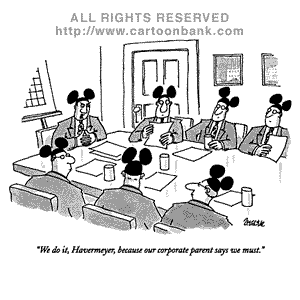
Perfection - Enemy of the Good
So - no sooner linked than picked upon, Lorne. I wouldn't be quite so charitable toward Steve Jobs' carrot juice tantrum. One person's quest for perfection is another person's nit-picking idiosyncrasy. Wouldn't orange juice have been OK? The behavior described veers perilously close to that of prima donna performers who must have all the brown M&M's removed from the bowl in the green room, and other such nonsense.
There are cases for perfection, and Jobs has certainly harnessed it to great advantage in molding Apple's design aesthetic. There's also no question that it's better to delay product launches to get them right than risk negative customer experiences by launching too early.
On the other hand, and particularly in fast-moving industries and situations, the quest for perfection can doom you with delay. Wait to launch your product until it is absolutely perfect, and you may find a competitor has already seized the advantage and market share with an inferior - but good enough - product. Try to draft the perfect contract and your customers will get frustrated and go elsewhere. And in the world of corp dev, try to negotiate the perfect deal and you won't get it done. The ideal of perfection must be balanced against considerations of time, cost and impact on other elements of the project. Getting it "as right as possible" within these contraints is key.
There are cases for perfection, and Jobs has certainly harnessed it to great advantage in molding Apple's design aesthetic. There's also no question that it's better to delay product launches to get them right than risk negative customer experiences by launching too early.
On the other hand, and particularly in fast-moving industries and situations, the quest for perfection can doom you with delay. Wait to launch your product until it is absolutely perfect, and you may find a competitor has already seized the advantage and market share with an inferior - but good enough - product. Try to draft the perfect contract and your customers will get frustrated and go elsewhere. And in the world of corp dev, try to negotiate the perfect deal and you won't get it done. The ideal of perfection must be balanced against considerations of time, cost and impact on other elements of the project. Getting it "as right as possible" within these contraints is key.
Corp Dev Confessions
I welcome another (perhaps the ONLY other) corp dev blog - Lorne Groe's "Confessions of a Corporate Dealmaker." I'm looking forward to comparing notes with Lorne on his experience in technology dealmaking.
Wednesday, January 25, 2006
No Deal Fever
Good to see that J&J didn't succumb to "deal fever" and chase the $27B proposal made by BSX. Still, as I posted last week, J&J could have had Guidant for several billion dollars less had they not overestimated their leverage in exercising the MAC clause. Perversely, Guidant's problems post-signing - which precipiated J&J exercise of the MAC clause - ended up creating $2B in shareholder value. It's a strange world.
Tuesday, January 24, 2006
Disney - Pixar Official
I posted last week about the rumored Disney - Pixar deal, and now it's official.
The more I think about this deal, the more sense it makes to me. No, Pixar isn't getting a big premium over where they were trading before the deal rumors started to fly. But Pixar has been hitting on all cylinders, and in the film business they are one flop away from losing 20% of their market cap. With this deal, Pixar shareholders get to lock their value in with very little risk of Disney (a moribund stock for years) taking a similar dive. Better yet, if the mouse follows through on preserving Pixar's independence and gives Ed Catmull real authority over the animation business, Disney could put on the kind of growth over the next few years that would only come at great risk for a standalone Pixar.
The more I think about this deal, the more sense it makes to me. No, Pixar isn't getting a big premium over where they were trading before the deal rumors started to fly. But Pixar has been hitting on all cylinders, and in the film business they are one flop away from losing 20% of their market cap. With this deal, Pixar shareholders get to lock their value in with very little risk of Disney (a moribund stock for years) taking a similar dive. Better yet, if the mouse follows through on preserving Pixar's independence and gives Ed Catmull real authority over the animation business, Disney could put on the kind of growth over the next few years that would only come at great risk for a standalone Pixar.
Worst Day of the Year
Apparently, January 24 is the single worst day of the year. This was particularly amusing to read this morning in Seattle, where the sun is shining on the Olympic range as we enjoy our first sunny day in months.
Friday, January 20, 2006
Disney - Pixar
I'm scratching my head a bit over the rumored Disney-Pixar tie-up, particularly since the merger price is right around Pixar's current value. Disney hasn't had a decent animated feature in years, while Pixar churns out smash after smash. You'd think Jobs would have all the leverage to get a premium deal. On the other hand, Pixar will need a new distro deal by mid-year, and the idea of Disney having the right to make muddled sequels to Toy Story and the like has got to be deeply grating to the creative types at Pixar.
Pixar's shares are near an all-time high, so perhaps Steve Jobs figures this is as good a time as any to cement the value, get Pixar control over sequels, and influence Disney's direction (and faster growth for former Pixar shareholders) via a BOD seat.
Pixar's shares are near an all-time high, so perhaps Steve Jobs figures this is as good a time as any to cement the value, get Pixar control over sequels, and influence Disney's direction (and faster growth for former Pixar shareholders) via a BOD seat.
Another Overused Term
"Walled Garden." Sounds great - peaceful, meditative, hell, maybe even romantic. In reality it's just a way to limit what you get to access on-line. My good friend Mike Naughton (no link, but he says he'll be blogging real soon. . .) offered this gem as a replacement: "Gulag Exercise Yard." It's just as visual as "walled garden", and a lot more accurate.
Thursday, January 19, 2006
Save it for Baseball
I'm in San Jose for the Wireless Communication Association symposium - look here for the buzz about Clearwire coming out of the show. It seems to be a very well-attended event this year, but walking the exhibition floor last night I immediately found an early contender for over-used cliche of the year: "Triple Play." Brilliant and rare in baseball, here at WCA the phrase seems to be spilling from everyone's lips, and was plastered on at least a half-dozen exhibition booths. Sure, it's fine to have shorthand for providing three services (voice, data, video) to a customer, but this is a hackneyed sports metaphor dressed up as an exciting new product ("triple play services!") that's nothing more than good old bundling.
Of course, I'm sure I'll find myself saying it in the months to come . . .
Of course, I'm sure I'll find myself saying it in the months to come . . .
Tuesday, January 17, 2006
Good to Be Guidant - Redux
After J&J's last offer, I said I would be disappointed if BSX didn't pull out the stops and make its best offer. It looks like they've done that, coming in WAY over the top with a deal valued at over $27B. That's something like a $3B increase over J&J's last offer, and for J&J to be competitive here they will need to go over the $25B they originally offered oh so long ago. J&J won't need to go to $27B, since they've still got the advantages of time and certainty of closing, and because the market is likely to take BSX stock down pretty viciously for fear of what this merger will do to the company's credit ratings. Still, it will take more than $25B for J&J to win Guidant, meaning the whole exercise of J&J declaring the MAC clause was a colossal strategic blunder, costing J&J time, money and quite possibly the opportunity to make this acquisition. Sometimes you've got to leave a few dollars on the table in order to make sure you get what you're after.
Monday, January 16, 2006
Setting Dates
I spent some time today dealing with an annoying and quite avoidable contract issue. Virtually all contracts have important dates - the date the agreement begins, the date it terminates or renews, the outside date upon which a merger can be terminated, the date puts, calls, shotgun rights or other exit mechanisms kick in – you name it. Far too often, these dates are defined based on future occurrences (e.g., “the contact term shall begin once X happens”), other agreements (“the contract term shall begin once Agreement Y is executed”), or, the bane of my existence today, both (“the contract term shall begin on the later of X happening or Agreement Y being executed”).
In the months following an agreement being entered into, terms like this will typically not cause much consternation. Everything you need is at hand. But let’s say you’re dealing with a partnership agreement, distribution contract, long-term lease or the like. Let’s say the original agreement was signed 10-15 years ago, it’s been amended four times and assigned twice. Maybe you’ve picked the agreement up in an acquisition. Now, you’ve got to track down all of those ancillary events and agreements just to determine how the contract is supposed to run, and perhaps even whether it is still in effect. Besides the annoyance, the need to track and follow this trail of dates and agreements greatly increases the chances that someone will inadvertently blow a date under the agreement. Sure, maybe it will be the other side, but do you really feel that confident about your own contract management tools?
I think that, wherever possible, these dates should be clearly set and determined within the contract itself. Yes, there are times when that doesn’t work. But I think that these undefined dates are usually more a product of laziness than inability to reach agreement. In my experience, mutually-acceptable dates can usually be set very easily, and you’re doing future handlers of your contracts a great service by setting them up this way.
In the months following an agreement being entered into, terms like this will typically not cause much consternation. Everything you need is at hand. But let’s say you’re dealing with a partnership agreement, distribution contract, long-term lease or the like. Let’s say the original agreement was signed 10-15 years ago, it’s been amended four times and assigned twice. Maybe you’ve picked the agreement up in an acquisition. Now, you’ve got to track down all of those ancillary events and agreements just to determine how the contract is supposed to run, and perhaps even whether it is still in effect. Besides the annoyance, the need to track and follow this trail of dates and agreements greatly increases the chances that someone will inadvertently blow a date under the agreement. Sure, maybe it will be the other side, but do you really feel that confident about your own contract management tools?
I think that, wherever possible, these dates should be clearly set and determined within the contract itself. Yes, there are times when that doesn’t work. But I think that these undefined dates are usually more a product of laziness than inability to reach agreement. In my experience, mutually-acceptable dates can usually be set very easily, and you’re doing future handlers of your contracts a great service by setting them up this way.
Saturday, January 14, 2006
Going to the Well . . .
I continue to be highly amused by the to-and-fro in the struggle for Guidant. Not surprisingly, J&J raised its offer last night, and Guidant promptly accepted. I think this is the fourth time the Guidant BOD has approved a merger partner - talk about your rapid lead changes! J&J's new proposal is basically the same economically as BSX's latest, but J&J has the timing and certainty of closing advantage. Those factors are very important to Guidant management - this isn't a matter of taking whichever offer is a quarter higher.
I'd be a littled surprised (and disappointed) if BSX took its ball and went home here. I'm sure they feel a bit worked by Guidant right about now, but with the Guidant shareholder vote in two weeks, they should pull out the stops and go as far as they can. They'll either get their prize or at least know they didn't let J&J walk away with Guidant for anything less than a premium price.
I'd be a littled surprised (and disappointed) if BSX took its ball and went home here. I'm sure they feel a bit worked by Guidant right about now, but with the Guidant shareholder vote in two weeks, they should pull out the stops and go as far as they can. They'll either get their prize or at least know they didn't let J&J walk away with Guidant for anything less than a premium price.
Friday, January 13, 2006
Good to be Guidant
Guidant has got to be feeling a little bit of sweet redemption these days. After months of being slapped around by J&J, including the indignity of accepting a reduced purchase price, Guidant has found itself in that holiest of spots for a seller - a bidding war.
BSX raised its bid this morning by $1 (from $72 to $73 per share). While that's less than a 1.5% increase, word is that BSX has included in its proposal a couple of terms designed to make its offer roughly equal J&J's in terms of certainty and timing of close. Essentially, BSX will do whatever divestitures necessary to get antitrust approval, and will add interest to the deal starting on the assumed date of a J&J close. With that kind of equalization, the folks at Guidant are liking the idea of finally getting the chance to smack J&J down.
While this likely isn't the last move we'll see, one thing is sure - J&J has got to be sorely regretting its decision to exercise the MAC clause and not rush to close the original deal.
BSX raised its bid this morning by $1 (from $72 to $73 per share). While that's less than a 1.5% increase, word is that BSX has included in its proposal a couple of terms designed to make its offer roughly equal J&J's in terms of certainty and timing of close. Essentially, BSX will do whatever divestitures necessary to get antitrust approval, and will add interest to the deal starting on the assumed date of a J&J close. With that kind of equalization, the folks at Guidant are liking the idea of finally getting the chance to smack J&J down.
While this likely isn't the last move we'll see, one thing is sure - J&J has got to be sorely regretting its decision to exercise the MAC clause and not rush to close the original deal.
Thursday, January 12, 2006
J&J - Guidant
I last posted about J&J - Guidant in mid-December, when Boston Scientific came in with a higher offer of around $25B. Now J&J has come up to $23.2B, and Guidant has accepted J&J's revised offer.
Why would Guidant take an offer that's $1.8B less?
First of all, it might not really be $1.8B less. If Guidant goes with BSX, there will be a breakup fee payable to J&J somewhere in the neighborhood of $700M. I haven't seen anything that indicates the BSX offer is net of that fee. Secondly, a deal with J&J can get closed months faster, which increases the NPV of the J&J deal relative to BSX. Finally - and this will be very important to Guidant given their experience the first time around - the J&J deal offers greater certainty of closing. You can be sure there will be virtually no chance of J&J exercising the MAC this time around, and J&J's size relative to BSX (nearly 10X bigger) reduces the chance of the acquiror getting buffetted by market forces before closing occurs.
Why would Guidant take an offer that's $1.8B less?
First of all, it might not really be $1.8B less. If Guidant goes with BSX, there will be a breakup fee payable to J&J somewhere in the neighborhood of $700M. I haven't seen anything that indicates the BSX offer is net of that fee. Secondly, a deal with J&J can get closed months faster, which increases the NPV of the J&J deal relative to BSX. Finally - and this will be very important to Guidant given their experience the first time around - the J&J deal offers greater certainty of closing. You can be sure there will be virtually no chance of J&J exercising the MAC this time around, and J&J's size relative to BSX (nearly 10X bigger) reduces the chance of the acquiror getting buffetted by market forces before closing occurs.
Tuesday, January 10, 2006
Alito Hearings
In the years since I’ve moved to corporate development, I can’t say that I’ve ever really missed being a lawyer. That said, I can’t shake some of the things that interested (or annoyed) me about being a lawyer. With my recent missives about over-lawyered term sheets, and having caught part of the Alito hearings while working out today, I’m just going to plunge into a week of lawyer-related posts.
First of all, Alito – watching his hearing today, the thought I kept coming back to was: “What the hell was Bush thinking in appointing Harriet Miers?” Look, I’m a Democrat, but I can’t find anything wrong with Alito. He’s a lawyer’s lawyer, and he comes off as being unstintingly reasonable, unflappable and very, very smart. He seems to be committed to following the law (including the principle of stare decisis), and not likely to be a conservative activist in the mold of Thomas or Scalia. The best the Dems can seem to come up with against the guy is a mistake he made in not recusing himself from a case and a couple of strategy memos he wrote while serving as a government staff attorney. I think the more senior and cagy Dems on the Judiciary Committee decided to give Alito a pass, realizing that they can’t stop his nomination and it would be self-defeating to try. I watched a good chunk of Dianne Feinstein’s questions, and they were awfully soft.
An aside: I don’t usually watch TV news, but I watched the Alito hearing on Fox news. I’ve heard, of course, how blatant Fox is with its conservative bias, and I was not disappointed – throughout the hearing a box would appear explaining legal terms used by Alito or the Senators. At one point, Fox offered this definition of judicial activism: “A judge who finds laws not written in the Constitution.” This definition, of course, only includes activism of the liberal kind. This was made doubly amusing by the fact that at the same time as the box appeared both Alito and his questioner, Republican Senator Mike DeWine, made frequent use of the more cogent definition of judicial activism – “a judge who substitutes his own opinions for that of the law.”
First of all, Alito – watching his hearing today, the thought I kept coming back to was: “What the hell was Bush thinking in appointing Harriet Miers?” Look, I’m a Democrat, but I can’t find anything wrong with Alito. He’s a lawyer’s lawyer, and he comes off as being unstintingly reasonable, unflappable and very, very smart. He seems to be committed to following the law (including the principle of stare decisis), and not likely to be a conservative activist in the mold of Thomas or Scalia. The best the Dems can seem to come up with against the guy is a mistake he made in not recusing himself from a case and a couple of strategy memos he wrote while serving as a government staff attorney. I think the more senior and cagy Dems on the Judiciary Committee decided to give Alito a pass, realizing that they can’t stop his nomination and it would be self-defeating to try. I watched a good chunk of Dianne Feinstein’s questions, and they were awfully soft.
An aside: I don’t usually watch TV news, but I watched the Alito hearing on Fox news. I’ve heard, of course, how blatant Fox is with its conservative bias, and I was not disappointed – throughout the hearing a box would appear explaining legal terms used by Alito or the Senators. At one point, Fox offered this definition of judicial activism: “A judge who finds laws not written in the Constitution.” This definition, of course, only includes activism of the liberal kind. This was made doubly amusing by the fact that at the same time as the box appeared both Alito and his questioner, Republican Senator Mike DeWine, made frequent use of the more cogent definition of judicial activism – “a judge who substitutes his own opinions for that of the law.”
Thursday, January 05, 2006
Managing Lawyers
I’ve spent a good part of my career as a lawyer, many of my good friends are lawyers, and I have great respect for the work lawyers do. There’s no question that proactive, thoughtful legal advice adds value to any enterprise or deal. Very effective, strategic legal counsel can even be a competitive advantage. However, to expand on my earlier post regarding not over-lawyering term sheets – it’s equally important to manage your lawyers once definitive documents are being negotiated.
If you are fortunate, your lawyers will understand your business, your objectives, your timelines and your risk tolerance. They will work smoothly with the other side’s lawyers and help you bring the deal in on time and on acceptable terms. If you are unfortunate, your lawyers will have no business judgment, obstinate manners and lack any ability to weigh risks and opportunities. They will blow your deal up over meaningless terms, leaving you to try to pick up the pieces.
It can be tempting for non-lawyer deal guys to hand great chunks of the work on the definitive agreements over to the lawyers to work out. However, until and unless you have confidence in how your lawyers work, you’ll want to stay involved in all of those discussions, even if it just means a lot of listening. It’s equally important to make sure you have an understanding with your lawyers about who is in charge on your deals. You are. In any deal, there will be a number of points where you will need to overrule your lawyer’s advice or the position they are pressing for. This makes sense, right? The lawyer SHOULD be pressing more aggressively, and the deal guy should be doing the big picture balancing of the overall deal. Unfortunately (and I’ve run into this across the table far too often), the deal guy will shrug and defer to the attorney on stuff they should be moderating. So the deal bogs down – or derails – while you try to sort it out. While this is less of a problem in smaller companies or when using outside counsel, it can be a major problem in dealing with in-house M&A counsel at larger companies.
If you are fortunate, your lawyers will understand your business, your objectives, your timelines and your risk tolerance. They will work smoothly with the other side’s lawyers and help you bring the deal in on time and on acceptable terms. If you are unfortunate, your lawyers will have no business judgment, obstinate manners and lack any ability to weigh risks and opportunities. They will blow your deal up over meaningless terms, leaving you to try to pick up the pieces.
It can be tempting for non-lawyer deal guys to hand great chunks of the work on the definitive agreements over to the lawyers to work out. However, until and unless you have confidence in how your lawyers work, you’ll want to stay involved in all of those discussions, even if it just means a lot of listening. It’s equally important to make sure you have an understanding with your lawyers about who is in charge on your deals. You are. In any deal, there will be a number of points where you will need to overrule your lawyer’s advice or the position they are pressing for. This makes sense, right? The lawyer SHOULD be pressing more aggressively, and the deal guy should be doing the big picture balancing of the overall deal. Unfortunately (and I’ve run into this across the table far too often), the deal guy will shrug and defer to the attorney on stuff they should be moderating. So the deal bogs down – or derails – while you try to sort it out. While this is less of a problem in smaller companies or when using outside counsel, it can be a major problem in dealing with in-house M&A counsel at larger companies.
Tuesday, January 03, 2006
Term Sheets - Over-Lawyering
Expanding on the point made in Brad Feld’s latest Term Sheet post re over-lawyering – a term sheet, useful tool as it is, is really nothing more than a handy way to keep track of the key deal terms the business people have agreed upon (in principle). It’s not a binding agreement; it’s a way to determine if you can even get to a binding agreement, and once there, a tool to facilitate the negotiation process.
As such, there’s no need to draft it with legal precision - that can wait for the definitive agreements. Sure, there are cases where you need legal input on key deal terms that are inherently "legal." Some deals will have key terms involving specific IP rights, or apportionment of environmental liabilities, or some other nasty thing that you'll want your attorney to review/draft. Other than that, if you're going to insist on having attorneys review or draft the whole thing, you might as well dispense with it and go straight to the definitives. I have been involved with plenty of deals where no term sheets were exchanged, and many where the “term sheet”, such as it was, consisted of nothing more than an exchange of e-mail. While it's true (as Brad points out) that more detailed term sheets are generally better, at some point the additional detail is outweighed by the cost in time spent at the term sheet phase.
As such, there’s no need to draft it with legal precision - that can wait for the definitive agreements. Sure, there are cases where you need legal input on key deal terms that are inherently "legal." Some deals will have key terms involving specific IP rights, or apportionment of environmental liabilities, or some other nasty thing that you'll want your attorney to review/draft. Other than that, if you're going to insist on having attorneys review or draft the whole thing, you might as well dispense with it and go straight to the definitives. I have been involved with plenty of deals where no term sheets were exchanged, and many where the “term sheet”, such as it was, consisted of nothing more than an exchange of e-mail. While it's true (as Brad points out) that more detailed term sheets are generally better, at some point the additional detail is outweighed by the cost in time spent at the term sheet phase.
Saturday, December 24, 2005
Holiday Time - M&A Time
I'm enjoying my first Christmas in at least 4 years in which I'm not neck deep in a deal. To judge by the spate of recently-announced transactions, I'm in the minority this year.
I spent nearly all of December 2001 in New York, working on a deal that we walked from abruptly as wireless valuations cratered rapidly in early January 2002. The following December saw a similar scene, only this time a much bigger deal that never made it out of Seattle before having the plug pulled. So much of this work is spent on things that never come to fruition . . .
December 2003 marked the beginning of the process of selling AT&T Wireless. I remember having a particularly acrimonious call with my counterpart at one of the bidders a day or two before Christmas, and then taking out some frustration by felling several trees that had been damaged in an ice storm the night before (the short-handled axe is an underappreciated tool). By last December, I was living a different kind of frustration, dealing with Cingular and its parents as we tried to divest several hundred million dollars of assets to comply with the DOJ's consent decree on the merger.
What is it about the holidays that brings out such a frenzy of deal-making? Does the winter's waning daylight, forcing us indoors, cause the kind of corporate conjugation New Yorkers would associate with blackouts? Or is it just the draw of doing holiday shopping in Midtown Manhattan?
I spent nearly all of December 2001 in New York, working on a deal that we walked from abruptly as wireless valuations cratered rapidly in early January 2002. The following December saw a similar scene, only this time a much bigger deal that never made it out of Seattle before having the plug pulled. So much of this work is spent on things that never come to fruition . . .
December 2003 marked the beginning of the process of selling AT&T Wireless. I remember having a particularly acrimonious call with my counterpart at one of the bidders a day or two before Christmas, and then taking out some frustration by felling several trees that had been damaged in an ice storm the night before (the short-handled axe is an underappreciated tool). By last December, I was living a different kind of frustration, dealing with Cingular and its parents as we tried to divest several hundred million dollars of assets to comply with the DOJ's consent decree on the merger.
What is it about the holidays that brings out such a frenzy of deal-making? Does the winter's waning daylight, forcing us indoors, cause the kind of corporate conjugation New Yorkers would associate with blackouts? Or is it just the draw of doing holiday shopping in Midtown Manhattan?
Monday, December 19, 2005
Google - AOL
Google's much-hyped investment in AOL illustrates the value of keeping deals as simple as possible. There can be a great deal of pressure, particularly in large organizations, to structure deals in a way that mitigates the most risk and pleases the most constituencies. That's fine in some cases, but not in a competitive bidding situation, and particularly not in a case like this, where the stakes were so high for Microsoft's opponent. Google NEEDED to keep AOL close, and Microsoft should have pulled out the stops to prevent this from happening.
Sure, valuation had a lot to do with it, but AOL certainly could have gotten the same price from Microsoft. However, while Google's deal is a straightforward minority investment with some ancillary commercial deals, Microsoft apparently insisted on structuring its investment as a joint venture.
If you're AOL, would you rather deal with an investor or a JV partner (with all the attendant minority rights, exit and management issues)? Couple that with Google's greater willingness to push the envelope on promoting AOL's ads, and this was probably an easy decision for AOL even if the parties were even on valuation.
Sure, valuation had a lot to do with it, but AOL certainly could have gotten the same price from Microsoft. However, while Google's deal is a straightforward minority investment with some ancillary commercial deals, Microsoft apparently insisted on structuring its investment as a joint venture.
If you're AOL, would you rather deal with an investor or a JV partner (with all the attendant minority rights, exit and management issues)? Couple that with Google's greater willingness to push the envelope on promoting AOL's ads, and this was probably an easy decision for AOL even if the parties were even on valuation.
Thursday, December 15, 2005
More J&J - Guidant
Good in-depth article via Wharton on use of MAC clauses. It will be amusing to watch this one play out now that Boston Scientific has lobbed a bid in near J&J's original price. Does J&J really believe Guidant's issues cripple it as an asset, or did J&J seize an opportunity to try and get a better price?
The article also alludes to the complicated decision-making process a seller has to go through in evaluating multiple offers. Price is important, but not everything. In a stock deal, the seller has to decide which buyer will do better integrating and realizing the synergies of the deal, thus creating more shareholder value in the new company. Guidant will also obviously be concerned about certainty of getting to closing at the agreed-upon price, given their experience with J&J (my guess is that a Guidant - BSX deal will have a VERY specific MAC clause). In other situations, sellers have to be concerned about closing happening at all. Foreign buyers, companies with activist shareholders, and large buyers who by the merger create industry concentration all may find themselves needing to offer a premium price to win the deal.
The article also alludes to the complicated decision-making process a seller has to go through in evaluating multiple offers. Price is important, but not everything. In a stock deal, the seller has to decide which buyer will do better integrating and realizing the synergies of the deal, thus creating more shareholder value in the new company. Guidant will also obviously be concerned about certainty of getting to closing at the agreed-upon price, given their experience with J&J (my guess is that a Guidant - BSX deal will have a VERY specific MAC clause). In other situations, sellers have to be concerned about closing happening at all. Foreign buyers, companies with activist shareholders, and large buyers who by the merger create industry concentration all may find themselves needing to offer a premium price to win the deal.
Thursday, December 01, 2005
Negotiation - Listening
I am modestly surprised at how consistently I still run across people in love with the sound of their own voice, who don’t pay enough attention to what others in the room are saying. For me, I’d guess that in a typical two-person business negotiation I do no more than 30-35% of the talking. I really prefer to listen, ask follow-up questions and keep the other side talking. I find this tremendously helpful in what I do, yet I still feel like listening is underappreciated as a negotiating tool.
I find two primary benefits to listening during a negotiation, but they can require different ways to focus the listening. The first is the easy one – listening to the other side’s point of view allows you to craft more creative solutions to their business problem that also work for you (the cliché “win-win” outcome), or more articulate and forceful arguments about why their positions are wrong or won’t work. Understanding what is really driving the people on the other side of the table is tremendously helpful. I don't mean understanding their negotiating positions - those are always right out in the open. I'm talking about the reasons why they are taking those positions, which often can only be gotten to via active listening and follow-up questions. Perhaps the other side has already received BOD approval to do the deal at a certain price, but will need to go back through the approval process to change the terms. Maybe the CEO got burned investing in his brother-in-law’s car dealership 20 years ago, and now the company insists on overreaching apportionment of liability. There's no end to the factors that can drive the positions we take in negotiation, but by actively listening (not just nodding your head robotically while mentally rehearsing your witty rejoinder) and asking probing questions, you can ferret these issues out and work on the solution to the real problem at hand.
The second benefit to listening, which can be harder to focus on because it seems inefficient, is what I call the “day in court” phenomenon. Some negotiators just need to be heard. It can be their egos, a need to be able to return to their senior management and truthfully report that they explained all of their positions to a receptive audience (an audience which still, incidentally, said “no”), or just a need to vent. But it can be hard to fight the urge to cut someone off. You’ll find yourself in a negotiation, and you know precisely what the other guy is going to say. You’re a smart fellow with lots of good uses for his time, so you cut in mid-sentence and say “no.” No question there are times, particularly in lengthy M&A negotiations, when you need to do this. But if it is your primary style you will come across as insufferably arrogant. That doesn’t make it easy to do business. Unless the other side has no leverage whatsover (and sometimes even then), bullying only makes them dig in. On important issues – even when I know without a doubt that I am going to reject the argument that is being spun to me – I will hear the person out, and perhaps even ask a follow-up question or two. It shows respect and indicates a consideration of the opposing point of view. The person I'm negotiating with can then accede to my point without feeling like they are knuckling under - and believe me, considerations of ego and face-saving are alive and well in American business negotiations. Furthermore, I have consistently found that opponents will treat my positions with greater deference if they feel I have fully considered theirs in reaching my conclusion.
I find two primary benefits to listening during a negotiation, but they can require different ways to focus the listening. The first is the easy one – listening to the other side’s point of view allows you to craft more creative solutions to their business problem that also work for you (the cliché “win-win” outcome), or more articulate and forceful arguments about why their positions are wrong or won’t work. Understanding what is really driving the people on the other side of the table is tremendously helpful. I don't mean understanding their negotiating positions - those are always right out in the open. I'm talking about the reasons why they are taking those positions, which often can only be gotten to via active listening and follow-up questions. Perhaps the other side has already received BOD approval to do the deal at a certain price, but will need to go back through the approval process to change the terms. Maybe the CEO got burned investing in his brother-in-law’s car dealership 20 years ago, and now the company insists on overreaching apportionment of liability. There's no end to the factors that can drive the positions we take in negotiation, but by actively listening (not just nodding your head robotically while mentally rehearsing your witty rejoinder) and asking probing questions, you can ferret these issues out and work on the solution to the real problem at hand.
The second benefit to listening, which can be harder to focus on because it seems inefficient, is what I call the “day in court” phenomenon. Some negotiators just need to be heard. It can be their egos, a need to be able to return to their senior management and truthfully report that they explained all of their positions to a receptive audience (an audience which still, incidentally, said “no”), or just a need to vent. But it can be hard to fight the urge to cut someone off. You’ll find yourself in a negotiation, and you know precisely what the other guy is going to say. You’re a smart fellow with lots of good uses for his time, so you cut in mid-sentence and say “no.” No question there are times, particularly in lengthy M&A negotiations, when you need to do this. But if it is your primary style you will come across as insufferably arrogant. That doesn’t make it easy to do business. Unless the other side has no leverage whatsover (and sometimes even then), bullying only makes them dig in. On important issues – even when I know without a doubt that I am going to reject the argument that is being spun to me – I will hear the person out, and perhaps even ask a follow-up question or two. It shows respect and indicates a consideration of the opposing point of view. The person I'm negotiating with can then accede to my point without feeling like they are knuckling under - and believe me, considerations of ego and face-saving are alive and well in American business negotiations. Furthermore, I have consistently found that opponents will treat my positions with greater deference if they feel I have fully considered theirs in reaching my conclusion.
Tuesday, November 15, 2005
J&J - Guidant Back On
Also not surprisingly, J&J and Guidant negotiated a new price - a $4B discount off the original price. Nice work by J&J. It's unusual enough for a buyer to invoke the MAC clause, but this discount - nearly 20% off the original price - is huge, and is likely well in excess of the drop in Guidant's value caused by post-signing events.
Monday, November 07, 2005
Guidant's MAC
Nor surprisingly, Guidant sued Johnson & Johnson today over the latter's backing out of its $26B acquisition. While there is never a good time for a business to have the wheels fall off, there are few that compare in terms of sheer bad timing to the period between signing and closing the sale of your company. Since signing the deal, Guidant has faced product recalls, Spitzer-ization, and an SEC investigation. J&J decided to invoke the Material Adverse Change provision in the agreement and declare the deal off. Of course, they'd be happy to put it back on - at a lower price.
I can really feel for Guidant, having spent most of 2004 working to close the acquisition of my company. I know that Guidant's senior management must have been living and dying by that MAC clause, wondering if the next shoe to fall would put their buyer over the top. This is why negotiating the MAC clause is so important for a seller. It's hard enough for a buyer to walk on a vague MAC clause, but if you are able to negotiate in some specific concepts - either storm clouds you are aware of or just big risks unique to your industry or operations - you will sleep a lot better at night. When we sold AT&T Wireless, we had a couple of really ugly issues hit our business in the midst of running our auction. With telecom mergers taking 9 months or more to close, we tried to push as much of the risk of those problems continuing onto the buyers. We also wanted to make it clear that the issues had been disclosed, the buyers knew about them, and they went ahead with the purchase anyway. Our one-paragraph MAC clause was the most bitterly-fought provision in the whole merger agreement, but it was well worth it.
As a seller, you care about nothing so much as certainty of closing. Every deal has specific issues that can impact whether you get to closing - regulatory approvals, shareholder votes, etc. - but the MAC clause is a constant, and something that deserves a great deal of attention when negotiating every deal. Of course, as a buyer you need to be equally aware of attempts to push too much into the MAC clause. Although the bar to invoking a MAC is very high to begin with, there's no point in boxing yourself in if it can be avoided - or unless you get sufficient price concessions.
I can really feel for Guidant, having spent most of 2004 working to close the acquisition of my company. I know that Guidant's senior management must have been living and dying by that MAC clause, wondering if the next shoe to fall would put their buyer over the top. This is why negotiating the MAC clause is so important for a seller. It's hard enough for a buyer to walk on a vague MAC clause, but if you are able to negotiate in some specific concepts - either storm clouds you are aware of or just big risks unique to your industry or operations - you will sleep a lot better at night. When we sold AT&T Wireless, we had a couple of really ugly issues hit our business in the midst of running our auction. With telecom mergers taking 9 months or more to close, we tried to push as much of the risk of those problems continuing onto the buyers. We also wanted to make it clear that the issues had been disclosed, the buyers knew about them, and they went ahead with the purchase anyway. Our one-paragraph MAC clause was the most bitterly-fought provision in the whole merger agreement, but it was well worth it.
As a seller, you care about nothing so much as certainty of closing. Every deal has specific issues that can impact whether you get to closing - regulatory approvals, shareholder votes, etc. - but the MAC clause is a constant, and something that deserves a great deal of attention when negotiating every deal. Of course, as a buyer you need to be equally aware of attempts to push too much into the MAC clause. Although the bar to invoking a MAC is very high to begin with, there's no point in boxing yourself in if it can be avoided - or unless you get sufficient price concessions.
Wednesday, November 02, 2005
Selling the Deal
Seth Levine’s post on why entrepreneurs shouldn’t view their initial meeting with a VC as a one-shot deal rang particularly true for me yesterday when I met with a company I’ve been trying to do a deal with for 6 months. So much of corporate development is creating relationships with likely targets, whether they be large companies with businesses or assets that may need to be spun off, or small ventures that could be rolled up one day. And when you make a call to pitch a particular deal idea, it’s highly likely that you’ll get some manner of “no”. Like an entrepreneur, the kind of “no” you get – and what you do with it – depends entirely on the relationships you can establish. The guys I met with yesterday have told me no several times, as have I to their counter-proposals, but we’ve continued to talk – amicably – about what could be done to meet both of our needs. The outcome of all this dialogue is that we have finally reached a deal that works.
Circumstances change, and a deal structure that doesn’t make sense to a seller today may make a world of sense in three months. Sure, I sometimes feel like the persistant salesperson. But by leaving the door open, by being proactive and calling just to check in, I greatly increase the chance of being in front of the deal when it finally makes sense. And it's not just timing and luck - those calls and dialogue build the trust and information exchange that can create a deal where it otherwise would not ever happen.
Circumstances change, and a deal structure that doesn’t make sense to a seller today may make a world of sense in three months. Sure, I sometimes feel like the persistant salesperson. But by leaving the door open, by being proactive and calling just to check in, I greatly increase the chance of being in front of the deal when it finally makes sense. And it's not just timing and luck - those calls and dialogue build the trust and information exchange that can create a deal where it otherwise would not ever happen.
Wednesday, October 26, 2005
Portland's Wireless Pipe Dream
I attended a presentation in Portland, Oregon this week on the City of Portland’s “Unwired Portland” initiative to bring WiMax/Wi-Fi to the city. Although Portland has wisely shied away from the prospect of owning and operating a system themselves, they’re still dreaming. The city wants a commercial enterprise to build a network that:
• Provides free access for all to a “walled garden” of city-related sites
• Provides low-cost access to the disadvantaged
• Provides high QOS service for public safety and other city uses
• Is lower cost to all end users than existing broadband options
• Is offered at wholesale cost to the city
• Is provided on an open access basis so any ISP can resell the service
There was lots of discussion about the wonders of wireless, bridging the digital divide and all the great things that could be done (wireless meter reading; on-site building permits, etc) with wireless, but little acknowledgement of the real obstacles to making this work. The hardware to build networks may be getting cheaper, but the cost of operating those networks and providing customer service is rising. Implicit in the City’s proposal is an assumption that existing commercial services generate such excess profits that operators will be clamoring to build and operate this, despite the multiple ways the City’s requirements drive margins down and costs up. That's not the case. While someone may step up to provide some of this initially (and even Google's much-touted proposal for San Francisco wouldn't come close to providing what Portland wants), I predict that there will never be a wireless service in Portland resembling the “wish list” above.
It’s a shame the City can’t scale back its plans and focus on something workable. Solve the City’s needs by buying service from commercial operators. Verizon offers EV-DO in Portland, and Cingular will be there with HSDPA within six months. Better yet, buy from Clearwire once we launch service there! As for the digital divide issue, are there really a lot of disadvantaged citizens out there, toting laptops but stymied from joining the rest of us on the internet by the lack of a free broadband wireless connection? Besides, Portland, like many cities, is full of free Wi-Fi hotspots. The Personal Telco project in Portland has set up free sites all over the place – in cafes, streets, parks, etc. Publicize those to the disadvantaged, set a few new ones up in easy-to-access places – in short, do the easy, quick things rather than the grand, overarching scheme.
• Provides free access for all to a “walled garden” of city-related sites
• Provides low-cost access to the disadvantaged
• Provides high QOS service for public safety and other city uses
• Is lower cost to all end users than existing broadband options
• Is offered at wholesale cost to the city
• Is provided on an open access basis so any ISP can resell the service
There was lots of discussion about the wonders of wireless, bridging the digital divide and all the great things that could be done (wireless meter reading; on-site building permits, etc) with wireless, but little acknowledgement of the real obstacles to making this work. The hardware to build networks may be getting cheaper, but the cost of operating those networks and providing customer service is rising. Implicit in the City’s proposal is an assumption that existing commercial services generate such excess profits that operators will be clamoring to build and operate this, despite the multiple ways the City’s requirements drive margins down and costs up. That's not the case. While someone may step up to provide some of this initially (and even Google's much-touted proposal for San Francisco wouldn't come close to providing what Portland wants), I predict that there will never be a wireless service in Portland resembling the “wish list” above.
It’s a shame the City can’t scale back its plans and focus on something workable. Solve the City’s needs by buying service from commercial operators. Verizon offers EV-DO in Portland, and Cingular will be there with HSDPA within six months. Better yet, buy from Clearwire once we launch service there! As for the digital divide issue, are there really a lot of disadvantaged citizens out there, toting laptops but stymied from joining the rest of us on the internet by the lack of a free broadband wireless connection? Besides, Portland, like many cities, is full of free Wi-Fi hotspots. The Personal Telco project in Portland has set up free sites all over the place – in cafes, streets, parks, etc. Publicize those to the disadvantaged, set a few new ones up in easy-to-access places – in short, do the easy, quick things rather than the grand, overarching scheme.
Friday, October 21, 2005
More on Working Capital
Questions about inventory and liabilities in working capital – a buyer’s level of concern about these matters will depend a lot on what kind of business is being purchased. In the case of inventory, I would usually have a physical audit done even where inventory is relatively nominal. It’s easy and cheap to do. I wouldn’t do it pre-closing, since there will be a closing statement of working capital that includes inventory levels. You can reconcile to that statement via a post-closing physical audit done as part of the working capital adjustment process. If the inventory records don’t reconcile the seller has to true up.
If inventory is a bigger part of the deal, unique, or of indeterminate quality, you’d want to physically review it as part of diligence. You might go so far as to get specific reps to address any particular inventory concerns. Typically, however, you’ll simply verify that inventory is present pre-close, take the closing statement, and then true up post-closing. In the corporate world, this work will most likely be done by your accounting team, so be sure to stay on their good side.
Liabilities are also pretty easy. You’re going to do a full diligence on your target, much of which will relate to accounting. It won’t take much digging to find understated or omitted payables. If you do find them, you’d want to consider walking – it’s a bit of a red flag . . . Lagging payables that come through post-signing should flow right into any working capital adjustment process.
Otherwise, you account for post-closing unknowns – whether unreported liabilities or litigation – via the reps and warranties and your indemnity rights (asset deals) and price (stock deals). That raises a subject for a later post – why thorough diligence is far more important in stock deals than it is in asset deals.
If inventory is a bigger part of the deal, unique, or of indeterminate quality, you’d want to physically review it as part of diligence. You might go so far as to get specific reps to address any particular inventory concerns. Typically, however, you’ll simply verify that inventory is present pre-close, take the closing statement, and then true up post-closing. In the corporate world, this work will most likely be done by your accounting team, so be sure to stay on their good side.
Liabilities are also pretty easy. You’re going to do a full diligence on your target, much of which will relate to accounting. It won’t take much digging to find understated or omitted payables. If you do find them, you’d want to consider walking – it’s a bit of a red flag . . . Lagging payables that come through post-signing should flow right into any working capital adjustment process.
Otherwise, you account for post-closing unknowns – whether unreported liabilities or litigation – via the reps and warranties and your indemnity rights (asset deals) and price (stock deals). That raises a subject for a later post – why thorough diligence is far more important in stock deals than it is in asset deals.
Tuesday, October 18, 2005
Working Capital
Brad Feld is running a very informative series on Letters of Intent; the latest post covers price and structure. Brad's comments on working capital shouldn't be taken lightly just because in his example they only account for $1 million in a $150 million deal - working capital is an area where it's very easy for the parties to talk past each other and end up with a very ugly dispute during negotiation of the definitives or even post-closing. It's also an area where you'll want to make sure your accounting professionals are at your side as you draft the LOI and the working capital provisions in the agreement.
While not a major issue in early stage companies, receivables can be a big point of contention in mature company deals, as they can represent several percentage points on the value of a deal. For example, a company selling for $100 million could easily have $4 million in receivables. Absent an explicit discussion of working capital (and many deals get to the point of drafting definitives without ever going through an LOI), the buyer may well assume that the $4 million receivable is an asset included in the purchase price, while the seller assumes it is on top of the purchase price as a working capital adjustment. This is not a negotiation you want to be having after you've already agreed on price.
As the buyer you might even consider detailing in the LOI the treatment of aged receiveables in the working capital adjustment. While you may pay full value for current receivables, you'll probably pay next to nothing (or nothing) for receiveables more than 90-120 days old, and a sliding scale in between. This will be a negotiation of its own, as it directly impacts purchase price. A lot will depend on where you are in diligence, whether the business is similar to your core business, and what your own internal rules are on creating reserves for receivables.
While not a major issue in early stage companies, receivables can be a big point of contention in mature company deals, as they can represent several percentage points on the value of a deal. For example, a company selling for $100 million could easily have $4 million in receivables. Absent an explicit discussion of working capital (and many deals get to the point of drafting definitives without ever going through an LOI), the buyer may well assume that the $4 million receivable is an asset included in the purchase price, while the seller assumes it is on top of the purchase price as a working capital adjustment. This is not a negotiation you want to be having after you've already agreed on price.
As the buyer you might even consider detailing in the LOI the treatment of aged receiveables in the working capital adjustment. While you may pay full value for current receivables, you'll probably pay next to nothing (or nothing) for receiveables more than 90-120 days old, and a sliding scale in between. This will be a negotiation of its own, as it directly impacts purchase price. A lot will depend on where you are in diligence, whether the business is similar to your core business, and what your own internal rules are on creating reserves for receivables.
Tuesday, October 11, 2005
Game Theory Nobel
The 2005 Nobel prize for economics went to a couple of long-time stivers in the field of game theory, Thomas Schelling and Robert Aumann. One central finding of game theory is that cooperation and giving up short term gains leads to greater long-term advantage. This finding is styled as counter-intuitive, but I suspect that to most who spend a lot of time negotiating it seems pretty obvious.
While there are situations that call for a take-no-prisoners, zero-sum style of negotiating, the vast majority of cases call for a more nuanced approach. Game theory experiments show that working cooperatively toward a mutually-acceptable solution, and even sometimes giving up points in the margins, ultimately leads to the best outcomes. How much more compelling is this conclusion in business, where most negotiations involve trading partners who you will deal with again and again?
While there are situations that call for a take-no-prisoners, zero-sum style of negotiating, the vast majority of cases call for a more nuanced approach. Game theory experiments show that working cooperatively toward a mutually-acceptable solution, and even sometimes giving up points in the margins, ultimately leads to the best outcomes. How much more compelling is this conclusion in business, where most negotiations involve trading partners who you will deal with again and again?
Friday, October 07, 2005
Ig Nobel-ists
I love the Ig Nobel prizes, awarded every year at Harvard by the Annals of Improbable Research for deserving works that meet this simple but expansive criteria: "Achievements that cannot or should not be reproduced."
See here for the complete list of 2005 winners, highlights of which include: Medicine - "Neuticles" replacement gear for fixed dogs, Literature - Nigerian e-mail scams, and Chemistry - a scientific study determining, once and for all, whether humans swim faster in water or in syrup (no, I'm not going to spoil the surprise by telling).
See here for the complete list of 2005 winners, highlights of which include: Medicine - "Neuticles" replacement gear for fixed dogs, Literature - Nigerian e-mail scams, and Chemistry - a scientific study determining, once and for all, whether humans swim faster in water or in syrup (no, I'm not going to spoil the surprise by telling).
Thursday, October 06, 2005
H.R. - actively harmful?
Great interview in Business Week Online with Marcus Buckingham. Despite the provocative title, Buckingham makes some great points about the need for managers and organizations to focus on developing their peoples' strengths rather than curing weaknesses.
Subscribe to:
Posts (Atom)